
Imagine the next big Seattle winter storm hits, the lights flicker out, and you’re left staring at a cold fridge and a dark living room. You want to keep your family comfortable, but the fear of “backfeeding” your panel or accidentally damaging your home’s wiring is enough to make anyone hesitate. When weighing a generator transfer switch vs interlock kit, the right choice depends on your budget and how much of your home you need to keep running during an outage.
It’s completely normal to feel overwhelmed by technical jargon and safety requirements. You deserve a reliable backup power setup that protects your expensive appliances and gives you true peace of mind. Since 1952, we’ve helped our neighbors stay safe and powered up, and we know that clarity is the first step toward a secure home. This business is built on honesty and hard work, and we want to ensure you feel supported throughout this process.
In this guide, you’ll discover the safest and most cost-effective ways to connect a backup generator to your electrical panel. We’ll break down the differences in hardware, ease of use, and National Electrical Code compliance. By the end, you’ll have the confidence to choose the right system and the right professional to get the job done correctly.
Key Takeaways
- Learn how to prevent dangerous backfeeding to protect your home and utility workers during severe Seattle winter storms.
- Explore why an interlock kit is a cost-effective, flexible solution for homeowners using portable generators.
- Understand the reliability of manual and automatic transfer switches for powering pre-selected, critical circuits with ease.
- Compare the upfront costs and operational benefits of a generator transfer switch vs interlock kit for your specific panel.
- Find out why professional installation is necessary to navigate local electrical permits and safety codes in Renton, Kent, and Auburn.
The Dangers of Backfeeding: Why You Need a Safe Generator Connection
Backfeeding is a term many homeowners hear but few truly understand until a crisis hits. In simple terms, it’s when electricity from your portable generator flows backward through your home’s electrical panel and out into the utility lines. This creates a lethal hazard for utility crews working to restore power during a storm. These workers expect the lines to be dead while they perform repairs. When a generator sends high voltage back into the grid, it can turn a routine fix into a life-threatening accident. It’s a risk that no homeowner should ever take with their neighbors or local service teams.
The National Electrical Code (NEC) exists specifically to prevent these tragedies. NEC Article 702 mandates that any optional standby system must use transfer equipment to prevent the accidental interconnection of normal and alternate power sources. This is why “suicide cords,” which are extension cords with two male ends, are both illegal and deadly. They bypass every safety protocol in your home. When you are deciding between a generator transfer switch vs interlock kit, you are choosing the legal, professional way to keep your home powered without endangering lives.
How a Disconnect Mechanism Works
To stay compliant with safety codes, your system must have a “Main-off” requirement. This means you cannot physically have the utility main breaker and the generator breaker turned on at the same time. A Generator interlock kit or a transfer switch provides this mechanical separation. It’s a fail-safe that protects your home’s internal wiring from being fried when the grid power finally returns. Beyond safety, professional installation is vital for your protection. Many insurance companies will deny claims for electrical fires if they find the backup system wasn’t installed by a licensed professional to meet local standards.
The Peace of Mind Factor
Living in the Seattle area means preparing for high winds and heavy rain every winter. When a storm knocks out the power in Renton or Auburn, the last thing you want is a sense of dread about your electrical panel. A properly installed connection allows any member of your family to restore power to the fridge and lights safely and simply. At Reinhart Electric, we’ve prioritized these safety-first standards since 1952. We believe every neighbor deserves the peace of mind that comes from a steady, honest partner. We make sure your system is a help during a storm, not a hazard.
Generator Interlock Kits: The Simple, Cost-Effective Solution
For many homeowners in the Renton area, a generator interlock kit is the most practical path to emergency power. An interlock is a specialized metal slide-plate that attaches directly to your existing breaker panel. It works by physically preventing the main utility breaker and the generator backfeed breaker from being “on” at the same time. This simple mechanical lock-out eliminates the dangers of backfeeding by ensuring your generator never sends power into the grid. When comparing a generator transfer switch vs interlock kit, the interlock stands out because it allows you to access any circuit in your home. You aren’t limited to just a few pre-selected lights. You can power the microwave for five minutes, turn it off, and then switch on the well pump or the furnace fan. This flexibility is a huge advantage during long outages. If you want a detailed walkthrough of how to use a generator interlock kit safely and correctly, our dedicated safety guide covers every step of the process for homeowners in King County.
Installation is generally straightforward for a licensed electrician. We install a new breaker in your panel that serves as the “inlet” for your generator power. The interlock plate is then mounted to ensure that this new breaker can only be flipped once the main utility power is cut off. It’s a robust, elegant solution that keeps your home’s electrical system organized and safe without the need for a bulky secondary panel.
Pros and Cons of Interlock Kits
The primary draw of an interlock kit is its affordability. The hardware itself is significantly less expensive than a dedicated transfer switch. Since we don’t have to rewire your entire panel or move circuits to a separate sub-panel, the labor is often more efficient. However, this system requires a bit more “brain power” from the homeowner. You must manually manage your electrical load. If you try to run every appliance at once, you’ll likely trip the breaker on your generator. It’s a manual process that requires a steady hand and a clear understanding of your home’s energy needs.
Is Your Panel Compatible?
Not every electrical panel is ready for an interlock right away. These kits are brand-specific. A kit designed for a Square D panel won’t fit a GE or Siemens model. You also need two empty, adjacent breaker slots at the very top of your panel for the generator connection. In many older Seattle homes, panels are already at maximum capacity or use outdated “split-bus” designs that aren’t compatible with modern interlock hardware. If your panel is crowded or shows signs of wear, it’s a good idea to have a professional look at your electrical panel configuration to see if an upgrade is necessary first. We’ve been evaluating local systems since 1952, so we can quickly tell you if an interlock is a safe fit for your home.
Manual and Automatic Transfer Switches: Professional Reliability
A manual transfer switch is often viewed as the “gold standard” for homeowners who want a dedicated, foolproof setup. Unlike the interlock kit discussed earlier, which works with your existing panel, a transfer switch is a separate electrical box installed adjacent to your main service. This box acts as a specialized sub-panel. You choose the most important circuits in your home, such as the furnace, kitchen outlets, and well pump, and wire them directly into the switch. When comparing a generator transfer switch vs interlock kit, many families prefer the switch because it removes the guesswork during a stressful power outage.
This “set it and forget it” configuration is particularly useful for commercial properties or homes with complex electrical needs. In a business setting, there is no time to manually toggle individual breakers. A transfer switch provides a clear, designated path for power that meets the highest professional standards. It’s a methodical approach that ensures your most vital equipment stays online without the risk of human error. Since 1952, we’ve helped neighbors find this kind of stability, treating every installation with the care it deserves.
The Benefits of Pre-Selected Circuits
One of the greatest advantages of a manual transfer switch is load control. Since you pre-select your circuits, you can’t accidentally overload your generator. If you have a 5,000-watt generator, we wire only enough circuits to stay within that capacity. This prevents the generator from stalling or tripping out when you need it most. The visual clarity of a separate box with its own labels makes it easy for anyone in the house to operate. You simply flip a few toggles, and your “must-haves” like the fridge and lights are back in action.
When to Choose an Automatic Switch
For those who want zero interruption, an Automatic Transfer Switch (ATS) is the ultimate solution. These are typically paired with permanent, whole-home standby generators rather than portable units. An ATS monitors the utility line constantly. If it detects a drop in voltage, it automatically starts the generator and switches the power over in seconds. When deciding on a generator transfer switch vs interlock kit for a permanent installation, the automatic switch is the clear winner for convenience. This is a critical feature for neighbors who rely on medical equipment or maintain a high-demand home office. It also integrates seamlessly with whole-house surge protection, adding a layer of safety for your sensitive electronics during Seattle’s high-wind seasons.
Interlock Kit vs. Transfer Switch: A Side-by-Side Comparison
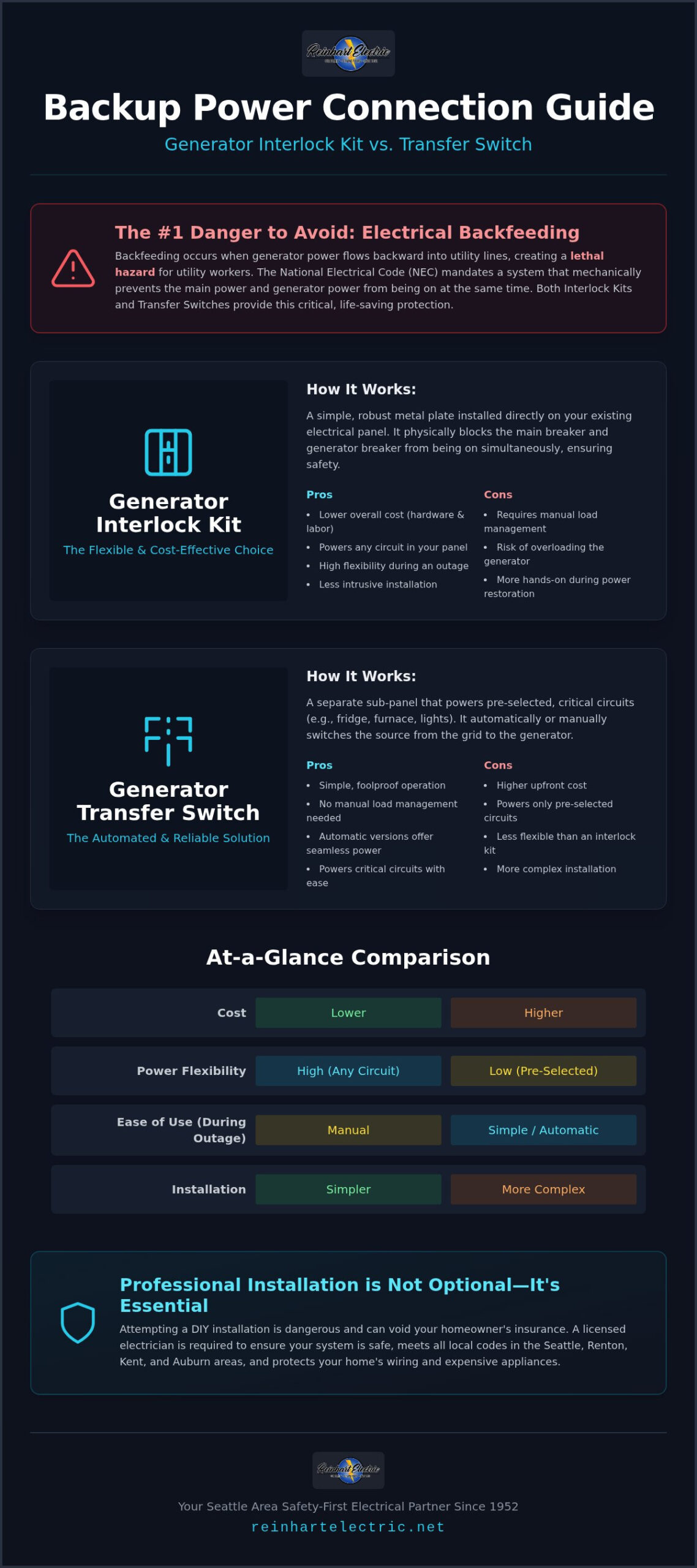
Choosing between a generator transfer switch vs interlock kit often comes down to how much you want to manage during a storm. An interlock kit is the most flexible option because it allows you to power any circuit in your main panel. You can decide in the moment whether to run the dishwasher or keep the upstairs lights on. In contrast, a manual transfer switch is limited to the specific circuits we hardwire into it during installation. While the transfer switch offers less flexibility, it provides a simpler user experience. You don’t have to worry about overloading the system because the “guardrails” are built into the limited number of circuits available.
The installation process for these two systems differs significantly. An interlock kit requires us to modify your existing panel by adding a new breaker and a sliding safety plate. This is often a more cost-effective path since it doesn’t require a secondary electrical box. A transfer switch is essentially a sub-panel. It involves more intensive wiring to move your critical loads from the main panel over to the switch. If you plan to upgrade to a larger generator in the future, the interlock kit scales better. It can handle whatever load your generator produces, whereas a transfer switch is capped by the number of circuits it was originally built to hold.
Choosing Based on Your Generator Type
Your choice should match the equipment you already own or plan to buy. For a standard 5,000-watt portable generator, an interlock kit is often the perfect companion. It lets you sip power across the whole house without a massive investment. If you’ve invested in a large 10,000-watt or larger dual-fuel unit, a heavy-duty transfer switch might be better to handle the high amperage consistently. We also help you determine the best spot for your power inlet box. In Seattle, we typically recommend placing it in a sheltered area near your garage or driveway so you don’t have to run long cords through the rain during a midnight outage.
The Convenience vs. Cost Decision Matrix
The sweet spot for most homeowners is the interlock kit because it balances a lower hardware cost with the total freedom to choose which rooms stay bright. If you live in an area with frequent, multi-day outages, the reliability of a transfer switch might justify the higher labor involved. We take the time to look at the age of your home and your specific panel brand to ensure everything meets modern safety standards. If you are ready to secure your home before the next storm, you can schedule a generator connection consultation with our team today. We’ve been providing honest, steady service to the community since 1952, and we’ll help you find the most dependable solution for your family.
Professional Installation in the Seattle Area: Why DIY Isn’t the Answer
While online forums might make a DIY installation look like a simple afternoon project, the reality inside a live electrical panel is far more complex. In the Seattle area, our damp climate and specific municipal codes in Renton, Kent, and Auburn add layers of difficulty that most tutorials ignore. Opening a panel exposes you to live bus bars that carry enough current to be fatal. A professional electrician doesn’t just hook up wires. We ensure every connection is torqued to specification and that your grounding system is robust enough to handle a sudden surge when the grid flickers back to life. When you are deciding between a generator transfer switch vs interlock kit, the technical execution is just as important as the hardware itself.
Navigating local permits is another hurdle for the DIYer. Each city in South King County has its own inspection requirements for backup power systems. We handle the paperwork and coordinate with inspectors to ensure your home remains fully compliant with the law. This professional oversight protects your property value and your insurance coverage. When you choose a professional, you also gain a warranty on both labor and parts. If a component fails during a midnight blizzard, you have a steady, reliable partner to call. We’ve been a family-owned staple in the community since 1952, and we stand behind every connection we make.
Local Expertise Since 1952
Our team has spent decades working in the unique homes of Burien and Des Moines. Older homes in these areas often have original panels that require a delicate touch and specific modern upgrades to be safe. We understand the unique challenges of the South King County grid, where power lines are often exposed to heavy evergreen growth and high winds. Our neighborly approach is built on trust. We treat your home like it’s our own. This means we never upsell you on a complex automatic system if a simple interlock kit fits your needs and budget perfectly.
Get Ready for the Next Storm
Booking an installation with Reinhart Electric is a straightforward, organized process. We start with a thorough evaluation of your current panel to determine if it can safely accept a new connection. Once the hardware is installed, we don’t just pack up and leave. We walk you through a full test of the system. We show you exactly how to connect your generator and flip the breakers safely. Our goal is to ensure you feel completely confident before the first snowflake falls. Contact Reinhart Electric today for a safe backup power solution!
Secure Your Home Before the Next Storm
Deciding on a generator transfer switch vs interlock kit is a vital step in protecting your family from unpredictable Seattle weather. Whether you choose the flexible, cost-effective interlock or the dedicated reliability of a transfer switch, the goal remains the same: a safe, code-compliant connection that eliminates the risk of backfeeding. You don’t have to navigate these technical choices alone.
Since 1952, Reinhart Electric has served as a steady hand for homeowners across the region. As licensed, bonded, and insured professionals, we bring over 70 years of local expertise to every panel we service. We also provide 24/7 emergency electrical support to ensure you are never left in the dark when it matters most. Our neighborly approach means we focus on what’s best for your specific home and budget without any high-pressure sales tactics.
Don’t wait for the clouds to gather before securing your backup power. Schedule your safe generator connection install with Reinhart Electric and gain the peace of mind you deserve. We look forward to helping you keep your lights on and your family comfortable all winter long.
Frequently Asked Questions
Is an interlock kit legal in Washington State?
Yes, generator interlock kits are legal in Washington State as long as they are UL-listed and meet National Electrical Code (NEC) requirements. The device must be a mechanical fail-safe that physically prevents the main breaker and the generator breaker from being on at the same time. Our team ensures every installation follows the specific safety standards required by the Washington Department of Labor and Industries.
Can I install a generator transfer switch myself?
You should not attempt to install a transfer switch yourself because it involves working inside a live electrical panel where a single mistake can be fatal. Professional installation is required to ensure the system is grounded correctly and that all wiring meets local safety codes. Licensed electricians have the training to handle high-voltage components safely, protecting your home from fire risks and ensuring your insurance remains valid.
How much does it cost to install a generator interlock kit in Renton?
The total cost for an installation in Renton depends on several factors, including the brand of your electrical panel and the distance between your panel and the outdoor power inlet box. Older panels may also require minor modifications or circuit adjustments to create space for the new generator breaker. We provide clear, transparent estimates after evaluating your home’s specific layout and power needs.
What size generator do I need to power my whole house?
Most Seattle area homes need a generator providing at least 7,500 to 10,000 watts to run essential appliances like a refrigerator, furnace fan, and well pump. You must account for “starting wattage,” which is the extra surge of power appliances need to kick on. When weighing a generator transfer switch vs interlock kit, remember that your generator’s capacity determines how many circuits you can safely run at once.
Do I need a permit for a generator transfer switch installation?
Yes, an electrical permit is required for any generator connection that involves modifying your home’s permanent wiring. This is true for both manual switches and interlock kits in King County. The permit process includes an official inspection, which serves as an extra layer of protection for your family. We handle the permit application and coordination with local inspectors as part of our professional service.
Will an interlock kit work with any electrical panel brand?
No, interlock kits are not universal and must be specifically engineered to match your panel’s brand and model. A kit designed for a Square D panel won’t fit onto a GE, Siemens, or Cutler-Hammer panel. During our initial visit, we identify your panel type to ensure the hardware is a perfect, safe fit. If your panel is an obsolete brand, we can discuss modern upgrade options to make your home storm-ready.
What is the difference between a manual and automatic transfer switch?
A manual transfer switch requires you to go to the panel and flip a switch yourself when the power goes out. An automatic transfer switch (ATS) is paired with a permanent standby generator and restores power in seconds without any human intervention. While an ATS offers the most convenience, many homeowners find that a generator transfer switch vs interlock kit comparison leads them to a manual option for its simplicity and lower cost.
How do I maintain my generator connection system?
You should test your system at least twice a year to ensure everything is working before a storm hits. Check the outdoor inlet box for any signs of debris, insects, or corrosion that could interfere with the connection. It’s also a good idea to have a professional electrician perform a quick safety inspection every few years to check for loose connections or wear on the mechanical interlock slide.