

Imagine standing in your garage during a heavy King County storm, flashlight in hand, while the rest of the neighborhood sits in total darkness. You have a portable generator ready, but the thought of accidentally “backfeeding” power into the utility lines or frying your new refrigerator keeps you from flipping the switch. It’s a common worry for many families in communities like Renton, Burien, Des Moines, Covington, Maple Valley, and Tukwila who want to stay prepared without risking their safety or their electronics.
We understand that electrical jargon can feel overwhelming when you just want the lights back on. This guide will teach you exactly how to use a generator interlock kit to take the guesswork out of emergency power. You’ll learn why this simple mechanical device is often the smartest, most cost-effective alternative to a complex transfer switch. We’ll walk through a clear, step-by-step procedure to keep your home running smoothly. By the end, you’ll have the peace of mind that comes from knowing your backup system is professional grade and perfectly safe for your family and the utility workers on the grid.
Key Takeaways
- Learn how a mechanical interlock kit acts as a physical safeguard to prevent dangerous electrical backfeeding during power outages.
- Discover why interlock kits are a cost-effective and flexible alternative to traditional transfer switches for home backup power.
- Master the exact shutdown and startup sequence to understand how to use a generator interlock kit safely without damaging sensitive electronics.
- Identify common hazards like “suicide cords” and understand why professional installation is necessary for Washington State code compliance.
- Gain the confidence to manage emergency power transitions yourself, ensuring your family stays safe and warm during the next storm.
What is a Generator Interlock Kit and How Does It Work?
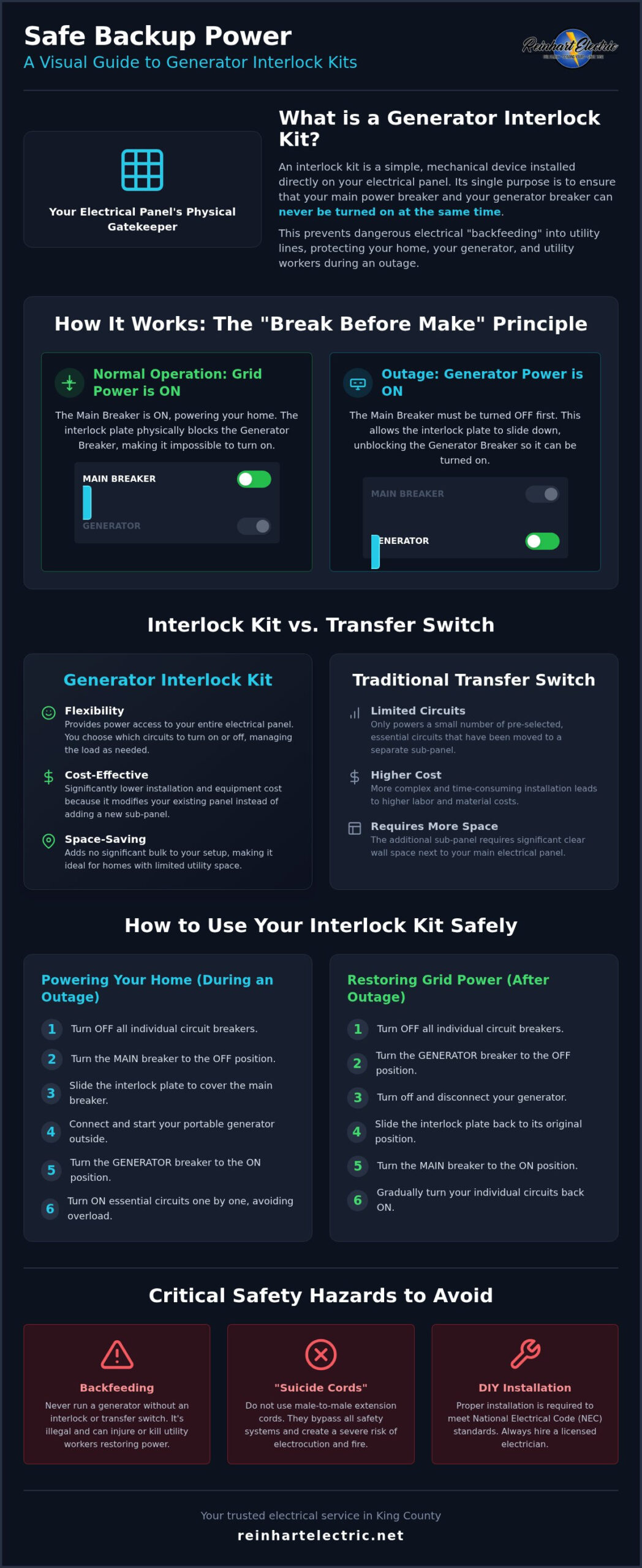
Learning how to use a generator interlock kit starts with understanding its role as a physical gatekeeper for your electrical panel. This device is the vital connection between your portable generator and your home’s wiring. While many people focus on the generator itself, the interlock is the component that makes the whole system safe. It’s a simple, mechanical solution that solves a complex safety problem. Without this device, your home’s electrical system remains a potential hazard during a blackout.
At its core, an interlock kit is a set of hardware designed to prevent your main breaker and your generator breaker from being turned on at the same time. This is critical because “backfeeding” power from a generator into the utility grid is illegal in Washington. It creates a massive safety risk for utility workers who are out in the storm trying to fix the lines. A standard kit from a professional installer includes several key parts:
- A heavy-duty sliding metal plate.
- Binder posts and specialized screws for secure mounting.
- Weather-resistant safety labels for the panel cover.
- Drill bits and hardware specifically sized for your panel brand.
The Role of the Sliding Plate
The sliding plate is the heart of the system. It creates a physical barrier that enforces a specific safety sequence. If your main utility breaker is on, the plate is pushed up, physically blocking the generator breaker from moving to the “on” position. To switch to backup power, you must first turn off the main breaker and slide the plate down. This mechanical design is far more reliable than relying on memory or a checklist during the dark, stressful moments of a power outage. These kits are precision-engineered for compatibility with major panel brands like Square D, Siemens, and Eaton, ensuring the sliding action is smooth and the fit is exact.
Preventing Backfeeding Safely
Backfeeding occurs when electricity flows out of your home and back into the neighborhood power lines. It can turn a “dead” wire into a live one, potentially injuring or killing linemen. By knowing how to use a generator interlock kit, you follow the “Break Before Make” principle. This means you must break the connection to the utility grid before you can make the connection to your generator. This process satisfies National Electrical Code (NEC) Article 702 requirements for optional standby systems. It’s a straightforward way to keep your home isolated from the grid, giving you peace of mind that your emergency readiness isn’t putting others at risk.
Interlock Kit vs. Transfer Switch: Which is Right for You?
Choosing between an interlock kit and a transfer switch often comes down to how much control you want over your home’s electrical panel. Both systems achieve the same goal: they keep your family safe and prevent dangerous backfeeding. However, they go about it in very different ways. Understanding how to use a generator interlock kit involves recognizing its simplicity as a physical sliding plate installed directly onto your existing panel. In contrast, a transfer switch is a separate sub-panel that requires moving specific circuits from your main panel into a new box.
If you are looking for a cost-effective solution, the interlock kit usually wins. Because it doesn’t involve complex re-wiring of individual circuits, the installation is much faster. This makes it an attractive option for many homeowners in King County who want professional-grade safety without the high price tag of a full sub-panel. Beyond cost, the biggest advantage is flexibility. With an interlock, you have access to every single circuit in your home. You just have to be mindful of your generator’s capacity. If you want to run the well pump for ten minutes and then switch to the water heater, you can do that simply by toggling the breakers.
Space is another factor. In smaller homes in Renton or Kent, electrical panels are often tucked into tight closets or crowded utility rooms. A transfer switch requires a significant amount of wall space right next to your main panel. If your wall is already full, an interlock kit is the perfect alternative since it adds almost no bulk to your setup. If you’re unsure which setup fits your home’s layout, our team can help you evaluate your electrical panel upgrades to find the best fit.
When to Choose an Interlock Kit
An interlock kit is the ideal choice for homeowners who want “whole-panel” access on a budget. It’s perfect for those who feel comfortable managing their own power loads. Since you decide which breakers to flip, you have total control over where your generator’s power goes. This is especially helpful if your needs change during a long outage. You might prioritize the furnace at night and the kitchen appliances during the day. Learning how to use a generator interlock kit gives you this versatility without the need for a bulky, expensive sub-panel.
When a Manual Transfer Switch Wins
A manual transfer switch is often better for users who prefer a “set it and forget it” approach. It limits you to a pre-selected list of 6 to 10 circuits, which simplifies the process for family members who might not be comfortable deciding which loads the generator can handle. If your main electrical panel is located in a hard-to-reach spot, like a high crawlspace or a cluttered corner, a transfer switch can be mounted in a more accessible location. While it lacks the flexibility of an interlock, it offers a simplified routine for those who want the most straightforward switchover possible.
Step-by-Step: How to Use Your Generator Interlock Kit
When the lights go out in King County, having a clear plan is essential. You want to move quickly but carefully to restore power to your family. Setting up your portable generator is the first step. Always place it in a well-ventilated outdoor area, at least 20 feet away from windows, doors, or vents. This prevents dangerous carbon monoxide from entering your home. Once the generator is in position, check the oil and fuel levels before you pull the starter cord.
The connection process is straightforward if you have a dedicated exterior inlet box. Use a heavy-duty, four-wire power cord to connect the generator to the inlet box. This setup is much safer than running extension cords through open windows, which can let in cold air or exhaust fumes. Understanding how to use a generator interlock kit ensures that you never accidentally connect your generator to a live utility line, keeping you and the utility crews safe.
The “Start-Up” Sequence
Following a strict order of operations protects your sensitive electronics and the municipal grid. Follow these five steps for a safe transition every time:
- 1. Turn OFF all branch breakers: This prevents a massive power surge from hitting your appliances when the generator takes over.
- 2. Turn OFF the Main Breaker: This step is vital. It isolates your home from the utility grid entirely.
- 3. Slide the interlock plate: Move the mechanical plate to reveal the generator back-feed breaker. The plate’s design makes it impossible to have the main and generator breakers on at the same time.
- 4. Start the generator: Let the engine warm up and stabilize for a minute or two before adding any load.
- 5. Turn ON the Generator Back-feed Breaker: Power is now safely flowing from the generator to your panel.
Managing Your Power Load
Once the generator is feeding the panel, you must decide which circuits to activate. Don’t flip every breaker at once. Start with your “must-have” items. The refrigerator, furnace fan, and a few LED lights are usually the first priorities. It’s helpful to understand the difference between “Starting Watts” and “Running Watts.” Many appliances, like your well pump or refrigerator, need a large burst of energy just to kick on. This is their starting wattage. Once they are running, the power demand drops to a lower running wattage.
Avoid running high-draw appliances simultaneously. For example, you shouldn’t try to run the central air conditioning and an electric oven at the same time. This could easily trip the generator’s internal breaker or stall the engine. By managing your load carefully, you ensure a steady, reliable flow of power until the utility company restores service. Mastering how to use a generator interlock kit gives you the flexibility to rotate power between different rooms as your needs change throughout the day.
Common Mistakes and Local Code Requirements
Even if you have memorized how to use a generator interlock kit, ignoring local codes can lead to serious legal and safety issues. In King County, electrical work isn’t just about getting the lights back on; it’s about meeting strict compliance standards. One of the most dangerous mistakes homeowners make is using a “suicide cord.” These are illegal, homemade cables with male plugs on both ends. They energize the exposed prongs, creating a lethal shock hazard for anyone who touches them. A professional installation replaces this dangerous shortcut with a permanent, code-compliant exterior inlet box.
In Washington State, DIY electrical installations can have long-term financial consequences. If an unpermitted interlock kit causes a fire or electrical failure, your home insurance provider may void your coverage entirely. King County requires specific electrical permits and a follow-up inspection for any generator integration. Inspectors look for a “Labeling” rule, which requires specific safety stickers on the panel cover. If these labels are missing or illegible, the installation will fail inspection, even if the hardware is installed correctly. Understanding how to use a generator interlock kit correctly also means knowing which shortcuts to avoid during the initial setup.
Safety Pitfalls to Avoid
Carbon monoxide is a silent killer that claims lives every year during power outages. You must keep your generator at least 20 feet away from your home, windows, and vents. Another common technical error involves the “Neutral-to-Ground” bond configuration. If your generator has a bonded neutral and your panel also has one, it can cause nuisance tripping or even damage sensitive electronics. The UL 67 standard is the essential safety benchmark for panelboards that ensures the enclosure and hardware can safely manage electrical distribution without failing under load.
Why Professional Installation Matters
A professional electrician does more than just screw a plate onto your panel. We verify the physical integrity of your entire electrical system before adding any new components. This includes ensuring the back-feed breaker is secured with a specialized “hold-down” kit, which is a requirement for safety. Without this kit, the breaker could accidentally be pulled out while it’s still energized. At Reinhart Electric, we bring over 70 years of local expertise to every job. We ensure your system is fully compliant with Seattle area codes and ready for the next storm. If you want to ensure your home is truly ready, we can help you install professional generator transfer switches and lockout kits that meet every safety standard.
Get Storm-Ready with Reinhart Electric & Service, Inc.
Reinhart Electric has been a steady partner for families in the Seattle area since 1952. We’ve seen our fair share of Pacific Northwest storms over the last seven decades. We know that when the power goes out, you need more than just equipment; you need a system you can trust. Our team focuses on providing transparent pricing for both interlock kits and inlet box installations so you know exactly what to expect. We don’t believe in high-pressure sales. Instead, we offer the honest, neighborly advice you’d expect from a business that has been part of the community for generations.
Choosing the right equipment is the first step in mastering how to use a generator interlock kit effectively. If your generator is too small, you’ll constantly trip breakers. If it’s larger than necessary, you’re wasting fuel and money. We help you calculate your home’s specific power needs, from your well pump to your home office. A quick safety audit before the next major Seattle storm can identify potential issues in your panel before they become emergencies. We want you to feel confident and prepared long before the first gust of wind hits your roof.
Our Local Service Area
We are proud to serve Renton, Kent, Auburn, and the broader King County community. As a family-owned business, we treat every home with the same care we’d give our own. While we strive to get your system “storm-ready” ahead of time, we also provide 24/7 emergency support for critical electrical failures. Our goal is to provide professional-grade results while maintaining the personal touch that has defined our business for over 70 years. We stay current on all local code changes to ensure your installation passes inspection the first time.
Next Steps for Your Backup Power
If you’re ready to move away from the hassle of extension cords, the first step is a professional consultation. We’ll inspect your current electrical panel to ensure it’s compatible with an interlock device. Many homeowners find that our “Generator Ready” package is the most convenient way to upgrade. This package includes the interlock hardware, a professionally installed exterior inlet box, and a complete walkthrough of how to use a generator interlock kit in your specific home. Don’t wait for the next blackout to test your readiness. You can schedule your generator interlock installation with Reinhart Electric today to ensure your family stays safe and comfortable through any weather.
Secure Your Family’s Comfort Before the Storm Hits
A power outage doesn’t have to be a source of stress for your household. By choosing a mechanical interlock kit, you gain a cost-effective and flexible way to manage your home’s energy without the risks of illegal backfeeding. You now understand the physical safeguards that protect both your electronics and our local utility workers. Knowing how to use a generator interlock kit correctly is the final piece of the puzzle for your emergency readiness plan.
Since 1952, Reinhart Electric has provided the Seattle area with dependable, professional-grade electrical solutions. Our licensed, bonded, and insured team is here to ensure your panel is compliant with all King County codes. We even offer 24/7 emergency service for those times when you need us most. Don’t wait for the next heavy rain or wind storm to test your backup system’s safety.
Get a Professional Generator Interlock Installation Quote from our family-owned team today. We look forward to helping you keep the lights on safely.
Frequently Asked Questions
Is a generator interlock kit legal in Washington State?
Yes, generator interlock kits are legal in Washington State as long as the hardware is UL listed and meets National Electrical Code (NEC) standards. They must be installed correctly to prevent backfeeding into the utility grid. Local inspectors in King County will verify that the kit is specifically designed for your panel brand and includes all required safety labeling before signing off on the installation.
Can I install a generator interlock kit myself?
While some homeowners are handy, we strongly advise against DIY installation for this specific safety device. Washington State law requires an electrical permit for this type of work; most home insurance policies require professional installation to maintain coverage. A licensed electrician ensures the back-feed breaker is properly secured and that the panel’s physical integrity isn’t compromised during the mounting process.
Do I need a special breaker for my interlock kit?
You will need a specific double-pole breaker that matches your panel manufacturer and model. This breaker acts as the entry point for your generator’s power. It must be installed in a specific location, usually the top right or left, so the sliding plate can function correctly. Additionally, NEC code requires a “hold-down” kit to prevent the breaker from being accidentally removed while it’s energized.
Will an interlock kit work with my solar panel system?
Interlock kits can be used in homes with solar, but the setup requires careful planning by a professional. Most grid-tied solar systems automatically shut down during a power outage for safety. If you want to use a generator while keeping your solar battery or panels active, you need a more complex wiring solution to ensure the two power sources never conflict. Our team can evaluate your specific system to ensure total safety.
What happens if I try to slide the interlock while the main breaker is on?
The interlock plate is designed to physically prevent this from happening. If the main breaker is in the “on” position, the metal plate will be blocked, making it impossible to flip the generator breaker. This mechanical interference is exactly why learning how to use a generator interlock kit is so much safer than relying on a manual checklist. It removes the possibility of human error during a stressful outage.
How much does it cost to have an electrician install an interlock kit in Renton?
The total cost for installation in Renton or Kent depends on several factors, including your panel brand and the distance to your exterior inlet box. While we don’t provide flat-rate pricing without an inspection, we focus on transparent estimates that cover the kit, the inlet, and the labor. Choosing an interlock is generally a more affordable path than installing a full manual transfer switch sub-panel.
Do I need a permit for a generator interlock kit in King County?
Yes, you definitely need an electrical permit for a generator interlock installation in King County. This permit ensures that a county inspector reviews the work to verify it meets current safety standards. Skipping the permit process can lead to fines and may cause significant issues if you ever decide to sell your home. We handle the permit process for our clients to ensure everything is documented correctly.
Can an interlock kit power my entire house?
An interlock kit gives you access to every circuit in your panel, but your generator’s wattage ultimately limits what you can run. You can power “must-have” items like lights and refrigerators easily. You’ll need to manage your load and avoid running high-draw appliances like central AC or electric dryers simultaneously. Understanding how to use a generator interlock kit allows you to move power around your home as your needs change.