
What if that rhythmic blinking in your kitchen isn’t just a dying bulb, but a diagnostic “smoke signal” from your home’s electrical heart? It’s unsettling to sit down for dinner only to have your overhead light start stuttering without warning. You’re likely wondering why are my lights flickering and, more importantly, if your family is safe. We understand that inconsistent lighting is more than just a minor annoyance; it often triggers a real fear of electrical fires or hidden system failures.
At Reinhart Electric & Service, Inc., we’ve helped our neighbors in Renton and Seattle navigate these exact concerns since 1952. This guide provides a clear path to troubleshooting the issue. You’ll discover the most common causes of flickering lights, from simple bulb swaps to serious electrical hazards, and learn exactly when it’s time to call a professional. We’ll walk through how to determine if the fix is a quick DIY task or a signal that your older home needs a safety audit to meet modern standards. Whether it’s a simple fix or an urgent 24/7 concern, we’re here to provide the peace of mind you deserve.
Key Takeaways
- Identify the scope of the issue by checking if the flicker is isolated to one bulb or affecting the whole house to narrow down the potential cause.
- Discover exactly why are my lights flickering by evaluating if your modern LED bulbs are incompatible with older, incandescent-style dimmer switches.
- Learn how high-demand appliances like air conditioners can trigger voltage fluctuations and when this indicates a need for a circuit or panel upgrade.
- Recognize the dangerous warning signs of electrical arcing and wire degradation that require immediate attention to protect your home from fire risks.
- Use our professional checklist to determine when a flickering light is a simple DIY fix versus an urgent safety hazard requiring an expert diagnostic.
Diagnosing the Pattern: Is It One Light or the Whole House?
Flickering is any visible fluctuation in light intensity or a rapid pulsing of the beam. It might look like a subtle dimming or a frantic strobe effect. When you find yourself asking, why are my lights flickering, the first step isn’t grabbing a ladder. It’s observation. Identifying the “scope” of the problem immediately tells us whether we are dealing with a minor localized nuisance or a systemic electrical threat. We recommend a methodical approach to narrow down the source before the situation escalates.
To get a clear picture of what’s happening, perform this 30-second diagnostic test. Turn on several lights across different rooms. Note if the flickering is rhythmic or random. Check if the pulsing starts exactly when a large appliance, like your refrigerator or dryer, kicks into gear. Finally, look at your neighbors’ homes to see if their exterior lights are behaving the same way. This simple process separates a loose bulb from a utility-side failure.
Scenario A: The Single Fixture Flicker
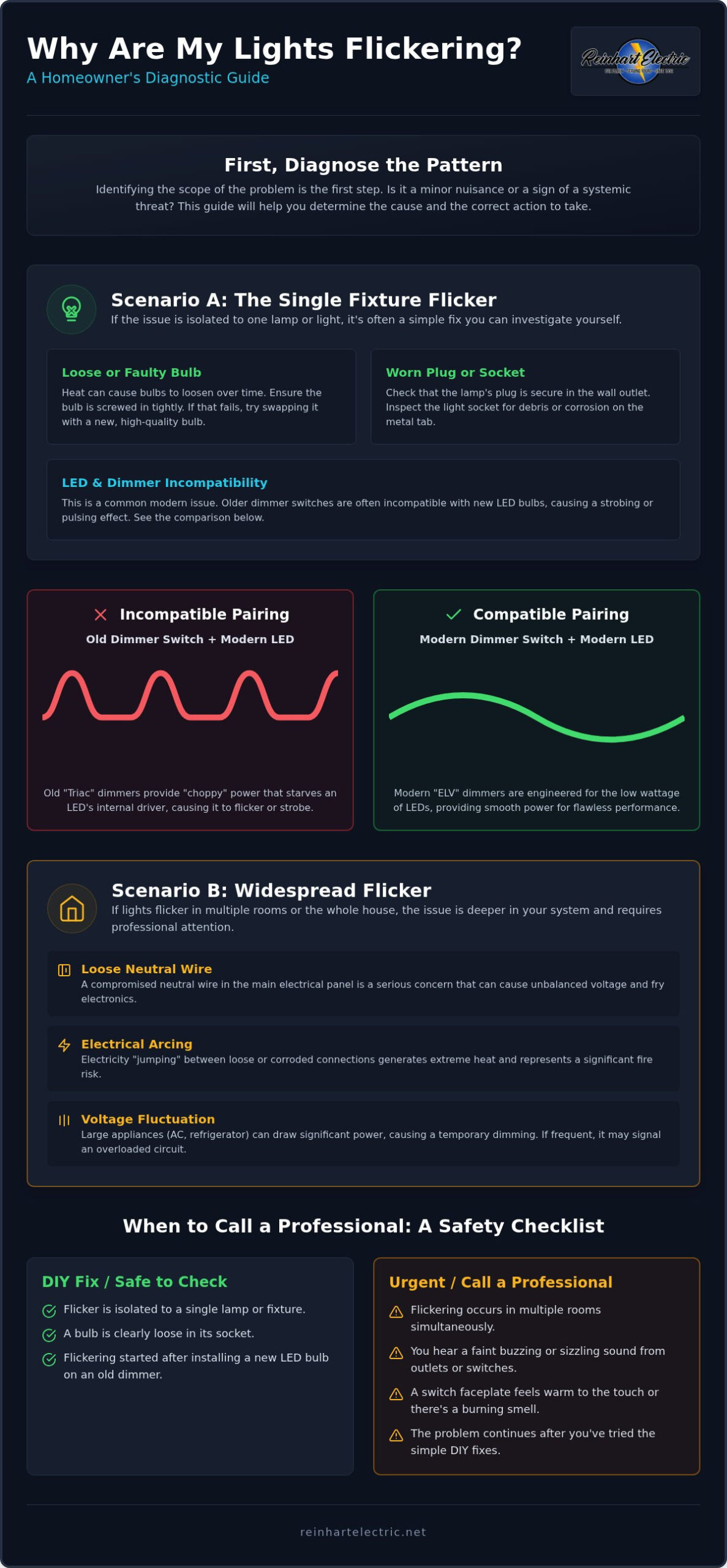
If the issue is limited to one lamp or overhead light, the fix is usually straightforward. Start with the basics: ensure the bulb is screwed in tight. Heat expansion can cause bulbs to loosen in their sockets over time. If the bulb is secure but the light still stutters, inspect the socket for dirt, debris, or “pitting” on the metal tab. For floor lamps, check the plug. A worn or loose outlet can interrupt the flow of electricity. If the fixture itself produces a faint sizzling sound or a burning smell, the internal wiring has likely reached the end of its lifespan and needs replacement.
Scenario B: Flickering Across Multiple Rooms
When lights in the kitchen and the hallway flicker at the same time, the problem is deeper in your system. This pattern often points to a loose neutral wire in your main electrical panel. A compromised neutral is a serious concern. It causes unbalanced voltage that can fry sensitive electronics and appliances. In many older homes throughout the Seattle area, widespread flickering can be a symptom of an Arc fault. This occurs when electricity “jumps” between loose or corroded connections. It generates extreme heat and represents a significant fire risk. If you notice your neighbors are also experiencing dimming lights, the fault may lie with a failing utility transformer. However, if the issue is unique to your home, it is a clear signal that your infrastructure needs a professional diagnostic check to ensure your family’s safety.
Common Culprits: Bulbs, Dimmers, and LED Incompatibility
If you’ve determined the flicker is isolated to a single room or fixture, the answer to why are my lights flickering often lies in the hardware itself. Modern lighting has changed significantly since we first started serving the community in 1952. Unlike the simple filaments of the past, LED bulbs are essentially tiny computers. They rely on an internal component called a driver to convert high-voltage AC into low-voltage DC. If the voltage isn’t perfectly steady, the driver might shut down and restart instantly. This creates a rapid pulsing effect that is physically exhausting to live with. High-quality bulbs use robust capacitors to smooth out minor utility power fluctuations, while budget-friendly “cheap bulbs” often lack these components, leading to early failure and constant blinking.
The LED vs. Dimmer Mismatch
Older dimmer switches were designed for incandescent bulbs that require a high energy draw. These “Triac” or leading-edge dimmers work by literally cutting off parts of the electrical wave to reduce brightness. While a traditional filament handles this “choppy” power without issue, it effectively chokes a modern LED driver. To get smooth performance, you usually need an Electronic Low Voltage (ELV) or trailing-edge dimmer. These are engineered to handle the low wattage of LEDs without the annoying strobe effect. Even if a bulb box is labeled “dimmable,” it doesn’t guarantee it will play nice with a switch installed twenty years ago. If your smart bulbs are acting up, even Wi-Fi interference from nearby routers can occasionally disrupt the digital handshake required for steady illumination.
Loose Connections at the Switch
Sometimes the problem isn’t the bulb or the technology, but the physical switch on your wall. Over decades of use, the internal spring mechanism in a toggle or slider switch can weaken or corrode. This creates a poor connection where electricity cannot flow steadily. If you feel heat on the faceplate or hear a faint buzzing sound when the lights act up, treat this as a major red flag. This indicates arcing, where electricity is jumping across a gap. This process generates enough heat to melt plastic and poses a significant fire risk. If your switches feel loose, warm, or noisy, it’s time to consider professional electrical repairs and troubleshooting to keep your home’s infrastructure safe and dependable.
High-Demand Appliances and Voltage Fluctuations
Have you noticed your kitchen lights dim for a split second every time the refrigerator kicks in? This is a common experience for many homeowners, and it often leads to the question: why are my lights flickering during these specific moments? The answer usually comes down to “inrush current.” Large appliances with powerful motors require a massive, momentary surge of electricity to start up. This surge can be several times higher than the power the appliance uses while running. In Seattle, we see this most often during seasonal shifts when homeowners first switch on their AC units or pull out space heaters for a cold snap.
A brief flicker is often within normal limits. Industry standards generally suggest that a voltage drop of 5% or less is acceptable. If your lights dim slightly and then immediately return to full brightness, your system is likely handling the load as intended. However, if the flickering persists, or if the lights stay dim for several seconds, you’re dealing with an excessive voltage drop. This indicates that your wiring or your panel is struggling to deliver the necessary current to every corner of your home.
Large Loads: AC Units, Dryers, and Microwaves
Your electrical panel is the gatekeeper of your home’s power. Many homes built decades ago were equipped with 100-amp panels, which were perfectly adequate for the appliances of that era. Today, with EV chargers and high-efficiency HVAC systems, that same panel can become dangerously overloaded. Signs of a failing panel include breakers that trip frequently, a warm bus bar, or visible corrosion inside the box. If your lights flicker throughout the entire house when any large load starts, it might be time for an Electrical Panel Upgrade King County. Upgrading to a 200-amp service provides the capacity needed for today’s technology while significantly reducing the risk of electrical fires.
Dangerous Infrastructure: Arcing and Outdated Wiring
While a loose bulb or a mismatched dimmer is common, sometimes the answer to why are my lights flickering is hidden deep within your walls. In our decades of experience serving the Renton area, we often find that flickering is the first warning sign of arcing. Arcing happens when electricity is forced to jump across a gap in a connection. This process creates intense heat that can exceed 10,000 degrees Fahrenheit. It’s often caused by “back-stabbed” outlets, where wires are simply pushed into the back of a device rather than secured under a screw. Over time, these spring-loaded connections weaken. This leads to a pulsing light and a significant fire hazard that requires immediate attention.
Living in the Pacific Northwest adds another layer of risk to your electrical system. Our damp basements and crawlspaces in cities like Kent and Auburn often lead to corrosion on electrical terminals. Moisture accelerates the breakdown of metal wire nuts and connections. When these connections fail, they don’t always cut power completely. Instead, they create a shaky, intermittent path for current that manifests as a flicker. If you suspect your home’s infrastructure is failing, it’s time to schedule professional electrical repairs and troubleshooting to identify these hidden dangers before they escalate.
Aluminum Wiring and Knob-and-Tube Risks
Many homes in our region built between 1965 and 1973 utilized aluminum wiring. Aluminum expands and contracts much more than copper when it carries a load. This “cold creep” eventually loosens the connections at switches and outlets, creating a gap for electricity to jump. Even older homes may still have knob-and-tube wiring in the attic or crawlspace. These legacy systems were never designed for the grounded loads of modern appliances. The rubberized cloth insulation on knob-and-tube becomes brittle with age and can crumble when touched. If you see white ceramic “knobs” or “tubes” in your attic, your system is likely overdue for a safety audit to prevent a catastrophic failure.
Loose Main Service Neutrals
A particularly dangerous cause of flickering is a loose main service neutral. The neutral wire provides the return path for electricity back to your panel. When it’s loose, you’ll notice an “unbalanced load” throughout the house. Some lights in your house may get extremely bright while others dim simultaneously. This isn’t just an annoyance; it’s a high-priority emergency. An unstable neutral can send excessive voltage into your delicate electronics. This can fry your computer, TV, or kitchen appliances in seconds. If your lights are behaving erratically across different rooms, treat it as an urgent safety issue that requires an immediate expert diagnostic check.
When to Call a Professional Electrician in Renton
While a simple bulb change often solves the mystery of why are my lights flickering, certain symptoms require immediate professional intervention. Electrical issues rarely fix themselves; they usually worsen until a failure occurs. If you encounter any of the following “Immediate Action” red flags, turn off the affected circuit and call for assistance right away:
- Persistent sizzling or crackling sounds coming from a switch or outlet.
- A distinct smell of burning plastic or ozone near electrical fixtures.
- Faceplates that feel hot to the touch or show visible discoloration.
- Flickering that persists even after turning off high-draw appliances.
Investing in a professional diagnostic is always more cost-effective than repairing the damage from a house fire. At Reinhart Electric & Service, Inc., we use advanced tools like thermal imaging cameras to see behind your walls. These cameras detect hidden hotspots where loose connections are generating dangerous heat long before they ignite. Because Reinhart Electric & Service, Inc. has served the local community since 1952, we understand the common failure points in both historic Seattle homes and modern Renton developments.
The Professional Diagnostic Process
The best way to handle flickering lights is to prevent them from happening in the first place. A comprehensive electrical safety audit can uncover issues like outdated knob-and-tube wiring or overloaded panels before they become emergencies. We often recommend modernizing your system with Arc-Fault Circuit Interrupter (AFCI) breakers. These specialized devices are designed to detect the specific signature of an electrical arc and shut down power instantly. This technology provides a critical layer of defense against the “silent” causes of electrical fires. For long-term stability, consider whole-house surge protection and panel modernization to shield your modern electronics from the fluctuations we’ve discussed. Don’t let a small flicker turn into a major hazard. Schedule your electrical troubleshooting and repair in Renton today to ensure your home’s electrical system is reliable and code-compliant.
Restore Safety and Steady Light to Your Home
Identifying why are my lights flickering is the first step toward maintaining the long-term health of your home’s electrical system. Whether the cause is a simple LED mismatch or a more complex infrastructure issue, addressing these symptoms promptly ensures your environment remains safe and functional. By choosing a methodical diagnostic path, you can eliminate anxiety and keep your family protected from hidden electrical risks.
Reinhart Electric & Service, Inc. has provided local reliability to the Renton and Seattle area since 1952. As licensed, bonded, and insured experts with an A+ rating for safety and reliability, we are committed to providing the steady hand your home needs. Request 24/7 Troubleshooting & Repair from Reinhart Electric & Service, Inc. to restore your peace of mind and ensure your electrical infrastructure is ready for the future.
Frequently Asked Questions
Is it normal for lights to flicker occasionally?
It’s normal for lights to dim slightly for a second when a heavy appliance like an air conditioner starts up. This happens because the motor requires a brief surge of power. If you find yourself wondering why are my lights flickering outside of these specific moments, it is likely a sign of a loose connection. Persistent flickering is never normal. It often points to a failing circuit breaker or a compromised neutral wire in your panel.
Can a bad light bulb cause other lights to flicker?
A single faulty bulb rarely causes other lights on the circuit to flicker. Most of the time, a bad bulb will simply blink or buzz on its own. If multiple fixtures are stuttering, the problem is usually located further back in the system. You might be dealing with a loose wire nut in a junction box or an overloaded circuit. We recommend testing the circuit with a different bulb type to rule out simple incompatibility.
Why do my lights flicker only when it’s windy outside?
If your lights flicker specifically during windstorms, the issue is likely outside your home. Wind can sway the overhead service lines that connect your house to the utility pole. This movement can pull on loose connections at the weatherhead or the service mast. Since these lines carry high-voltage current, this is a serious safety concern. You should contact your utility provider or a licensed electrician in Renton to inspect the service entrance.
Could flickering lights be a sign of a haunted house or just bad wiring?
While movies often use flickering lights to suggest a haunted house, the cause is grounded in physics. In older homes across Auburn and Burien, legacy wiring like knob-and-tube or aluminum is the most common culprit. These systems struggle to handle the electrical demands of modern life. If your lights are behaving erratically, it’s a signal from your home’s infrastructure that it needs a professional safety audit rather than a ghost hunter.
How much does it usually cost to fix flickering lights?
The cost to resolve flickering issues depends entirely on the underlying cause. A localized problem like a worn-out dimmer switch is a straightforward repair. However, if the flicker is caused by an outdated main panel or degraded service lines, the scope of work is larger. We provide thorough troubleshooting to identify the exact fault. This ensures you only pay for the necessary repairs needed to keep your home’s electrical system safe and code-compliant.
Will whole-house surge protection stop my lights from flickering?
Whole-house surge protection is designed to block sudden voltage spikes from external sources like lightning or grid switching. It doesn’t typically stop flickering caused by internal issues like loose wiring or voltage drops from large appliances. However, surge protection is a critical investment for protecting your sensitive electronics from the damage that often accompanies unstable power. It works best as part of a comprehensive system that includes a modernized electrical panel.
What should I do if I smell burning near a flickering light?
You must act immediately if you detect a burning smell near any electrical fixture. This scent indicates that components are melting because of intense heat from an electrical arc. Turn off the power at the main breaker panel right away to stop the flow of electricity. Do not attempt to use the light or the outlet again until it has been inspected. Our team is available 24/7 in the Seattle area for these urgent safety situations.
Can a smart home system cause light fluctuations?
Smart home technology can sometimes lead to light fluctuations. This often happens due to Wi-Fi interference or a weak signal that disrupts the digital communication between the bulb and the hub. Additionally, many smart dimmers require a dedicated neutral wire to function correctly. If a smart switch is installed in an older home without a neutral wire, it may cause the lights to pulse or flicker when set to lower brightness levels.