

What if that rhythmic pulsing in your kitchen light isn’t just a nuisance, but your home’s way of shouting for help? It’s easy to ignore a slight shimmer when you’re busy with dinner, but wondering why are my lights flickering is often the first step in preventing a serious electrical issue. We understand how unsettling it feels to see your lights dim or dance without warning. You want to know if you’re dealing with a simple loose bulb or a hidden fire hazard that needs immediate attention.
Since 1952, our family has helped neighbors in Renton and Kent navigate the quirks of aging electrical systems with honest, steady guidance. This guide will help you discover the most common causes of flickering lights, from minor bulb mismatches to critical issues like loose neutral bars or overloaded circuits. You’ll learn exactly how to troubleshoot these symptoms safely and, more importantly, recognize the warning signs that mean it’s time to bring in a professional. Our goal is to replace your anxiety with the peace of mind that comes from a safe, reliable home.
Key Takeaways
- Learn to distinguish between a simple bulb replacement and serious systemic issues that impact your home’s safety.
- Discover the technical answers to why are my lights flickering, including the hidden dangers of loose wiring and overloaded circuits.
- Identify the warning signs of a “loose neutral” or failing transformer before they lead to costly damage or fire hazards.
- Understand why a flickering light combined with a warm-to-the-touch outlet is a critical emergency that needs immediate attention.
- Find out how professional diagnostics like thermal imaging can map out your home’s electrical health and provide long-term peace of mind.
Understanding Why Your Lights Are Flickering: Simple vs. Serious Causes
Flickering is technically an intermittent interruption in your home’s electrical current. While it might seem like a small annoyance, your electrical system acts much like a human nervous system. Your light fixtures are the visible parts of a vast, hidden grid that stretches behind your walls. When a light pulses or dims, it’s often a symptom of a message being sent from deeper within that grid. If you are asking why are my lights flickering, the first step is determining if the issue is isolated to a single bulb or if it’s a systemic problem affecting your entire home.
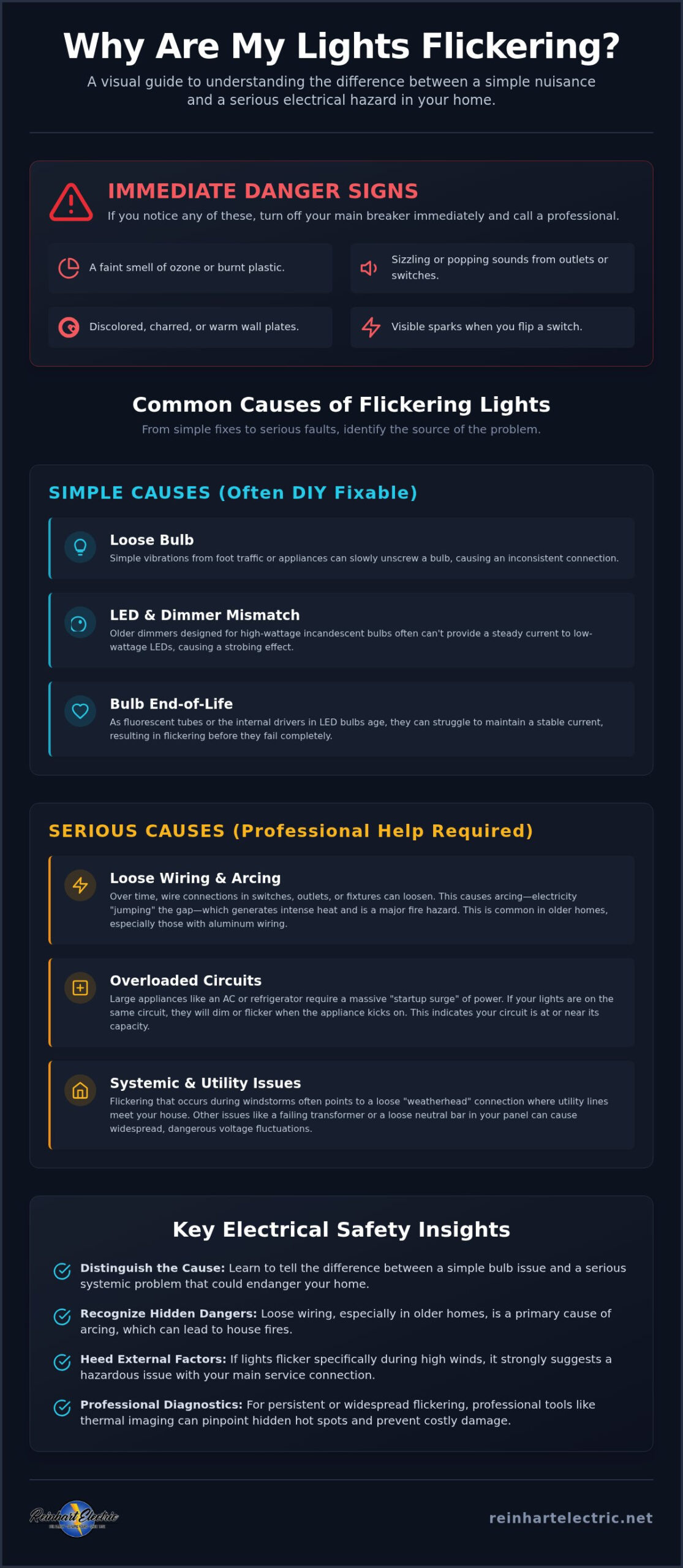
The technical phenomenon of Flicker (light) is often caused by rapid voltage fluctuations. In many cases, this is harmless, but certain patterns require immediate action. Before you begin troubleshooting, run through this safety checklist. If you notice any of the following, turn off your main breaker and call a professional immediately:
- A faint smell of ozone: This often smells like burnt plastic or a post-thunderstorm scent.
- Sizzling or popping sounds: These noises coming from a switch or outlet indicate active electrical arcing.
- Discolored wall plates: Any charring or browning on an outlet is a sign of extreme heat.
- Visible sparks: If you see a flash when you flip a switch, the internal components have failed.
The Quick Fixes: Bulbs and Compatibility
Many homeowners in the Seattle area find that their flickering is actually a simple hardware mismatch. Standard vibrations from nearby appliances or heavy foot traffic can slowly unscrew a bulb over time, causing it to lose a steady connection. However, the most common modern culprit is a mismatch between LED bulbs and older dimmer switches. Traditional dimmers were designed for incandescent bulbs that draw more power. When they’re paired with low-wattage LEDs, the electrical load isn’t consistent, leading to a strobe-like effect. Additionally, as fluorescent tubes or LED drivers reach the end of their lifespan, they often struggle to maintain a steady arc, resulting in persistent flickering before they fail completely.
When the Flicker Signals a Deeper Issue
If the flickering persists after you’ve changed the bulb, you may be dealing with arcing. This happens when electricity “jumps” across a gap in a loose wire or a damaged connection. Arcing generates intense heat and is a leading cause of house fires. You should also watch for a “brownout” effect, where lights dim and stay dim for several seconds. This usually points to a significant voltage drop. A major red flag for homeowners in Renton or Kent is why are my lights flickering only during windstorms. If the pulsing happens when the wind picks up, it almost always indicates a loose weatherhead connection where the utility lines meet your house. This is a serious fault that requires a professional inspection to prevent a total loss of power or a fire.
Internal Electrical Culprits: Loose Wires and Overloaded Circuits
While a loose bulb is an easy fix, the answer to why are my lights flickering often lies deeper within your walls. Every switch, outlet, and fixture in your home relies on physical connections. Over time, the terminal screws holding wires in place can loosen. This creates electrical resistance. Resistance generates heat, and heat causes the metal to expand and contract. This cycle eventually makes a once-secure connection unstable. When electricity struggles to flow through these loose points, it creates the visible pulsing you see in your lamps.
Loose Wiring at the Fixture or Switch
In our decades of service since 1952, we’ve seen how time affects even the best installations. In older homes across Auburn and Kent, aluminum wiring was a common choice during the 1960s and 70s. Aluminum expands more than copper, which leads to loose connections much faster. If you hear a faint buzzing sound or notice a switch plate that feels warm, these are critical warning signs. Even in newer builds, many contractors use “back-stabbed” wiring. This is where wires are pushed into a spring-loaded slot rather than being wrapped around a screw. These connections are notorious for failing and causing intermittent power issues.
Circuit Overload: The Large Appliance Effect
It’s a common scene: the air conditioner kicks on, and the living room lights take a sudden dip. This happens because large appliances require a massive “startup surge” of amperage to get their motors running. If your lights are on the same circuit as a refrigerator or microwave, they’ll dim momentarily as the appliance grabs the available power. While a brief flicker is often normal, persistent dimming suggests your home is struggling to meet modern energy demands. Following industry standards for flicker, we often find that installing a dedicated circuit for heavy appliances is the only way to stabilize the voltage.
The neutral wire also plays a quiet but vital role. It completes the circuit and returns electricity to your panel. If the neutral connection is loose, the voltage in your home can swing wildly, causing some lights to brighten while others dim. This instability is a major fire risk. If you suspect your home’s internal wiring is reaching its limit, our team provides expert electrical repairs and troubleshooting to keep your family safe. We believe in getting the job done right the first time, ensuring your home’s grid remains steady for years to come.
Systemic Issues: Voltage Fluctuations and Utility Problems
Sometimes the answer to why are my lights flickering isn’t found in a single switch or a specific appliance. If you notice pulsing across multiple rooms or throughout your entire house, the problem is likely systemic. In our region, many homes still rely on aging electrical panels from brands like Zinsco or Federal Pacific. These units were common in mid-century Seattle builds but are now known for internal failures. Their bus bars often lose their grip on breakers, creating a poor connection that causes lights to shimmer. If your panel is over 40 years old, it may simply be unable to maintain the steady 120V flow your modern electronics require. You can often spot these voltage fluctuations if you notice that light bulbs seem to burn out much faster than their rated lifespan, which is a common sign your home is receiving more than the standard 120V.
The Danger of a Loose Main Neutral
The most alarming cause of whole-house flickering is a loose or “open” neutral wire at your main service entrance. In a standard electrical system, the neutral wire acts as a balance beam between two 120V legs of power. When this connection fails, the balance is destroyed. You might notice a strange phenomenon where some lights get unusually bright while others dim to a faint glow. This isn’t just a nuisance. It can send up to 240V through a circuit designed for half that amount, literally frying your television, computer, or refrigerator. If you see this specific pattern, it’s a true electrical emergency. We recommend calling for electrical repairs and troubleshooting immediately to prevent a fire or total equipment loss.
Utility Side Issues: Puget Sound Energy vs. Seattle City Light
Before assuming the fault lies within your walls, check with your neighbors. If people on both sides of your street are asking why are my lights flickering, the issue likely rests with the utility provider. Whether you are served by Puget Sound Energy or Seattle City Light, the service drop, which are the wires running from the pole to your house, is exposed to the elements. In the Pacific Northwest, tree limbs, heavy winds, and even curious squirrels can damage these lines. A failing transformer on the street can also cause voltage fluctuations that ripple through every home on the block. If your neighbors are dark too, the utility company is responsible for the repair. However, if the damage is at the “mast” where the wires connect to your roof, that repair typically falls to the homeowner.
Warning Signs Beyond the Flicker: Why You Might Need Hot Outlet Repair
Flickering lights are often the most visible symptom of an electrical fault, but they are rarely the only one. While the pulsing in your living room might seem like a separate issue from a plug in your kitchen, they are frequently connected by the same underlying problem: resistance. When electricity meets resistance due to a loose wire or failing insulation, it creates heat. If you have spent the evening wondering why are my lights flickering, take a moment to place your hand near your wall outlets. A flickering light is a warning, but a hot outlet is a critical emergency that indicates your home’s wiring is actively failing.
Modern electrical safety has advanced significantly to catch these issues before they become catastrophic. One of the most important tools in a modern home is the Arc Fault Circuit Interrupter (AFCI). These specialized breakers are designed to detect the specific electrical signature of arcing, which is the “jumping” of electricity that causes both flickering and intense heat. As Washington State moves toward adopting the 2026 National Electrical Code, AFCI protection is becoming a standard requirement for nearly every room in the house. If your home lacks these safety devices, a simple flicker can quickly escalate into a fire hazard without a breaker ever tripping.
Identifying a Hot Outlet
You can safely check the temperature of your outlets by placing the back of your hand near the faceplate. Do not touch any exposed metal parts or the prongs of a plugged-in device. If the plastic feels warm or hot to the touch, the internal insulation is likely failing. This is often a sign of “creeping” resistance, where a connection has slowly loosened over years of use. Interestingly, you might notice the lights flickering on one side of a room while an outlet on the opposite wall begins to heat up. This happens because outlets are often “daisy-chained” together on a single circuit. A failure at one point in the chain affects everything downstream.
Discoloration and Odors: The Point of No Return
There are two signs that mean you have reached the point of no return: a fishy smell and visible discoloration. Electrical insulation is made of plastic and chemicals that release a distinct, pungent odor when they begin to melt. Many homeowners mistake this for a plumbing issue or a dead pest in the wall, but it is actually the smell of a fire in its earliest stages. If you see any browning, charring, or warping on the plastic faceplate, the internal temperature has already exceeded safe limits. Never simply unplug the device and ignore the outlet. The damage is already done to the wires behind the wall. If you notice these symptoms, turn off the breaker immediately and contact us for electrical code updates and safety compliance to secure your home.
Professional Troubleshooting and Repair in the Seattle Area
Electrical troubleshooting is a precise trade that requires more than just a basic voltage meter. While understanding the common causes of why are my lights flickering can help you spot a problem, attempting to fix internal wiring yourself is incredibly risky. High-voltage systems can be unforgiving. A single mistake during a DIY repair can lead to severe injury or create a code violation that complicates your home insurance. Since 1952, our family has served neighbors in Renton, Kent, and the greater Seattle area with a focus on safety and transparency. We believe in providing a steady hand and clear answers so you can feel confident in your home’s electrical health.
Our diagnostic process goes beyond the surface. We use advanced tools like thermal imaging to detect heat signatures behind your walls that the human eye cannot see. This allows us to find arcing or failing insulation before it ever becomes a fire. We also perform detailed circuit mapping to ensure your home’s “nervous system” is organized and capable of handling your daily needs. If the issue rests with the utility side, we can help you coordinate with Seattle City Light or Puget Sound Energy to ensure the service drop and weather head are functioning correctly.
What to Expect During a Troubleshooting Visit
When our team arrives, we start with a comprehensive audit of your main panel and any sub-panels. We look for signs of wear, loose terminal screws, and outdated components that might be the reason why are my lights flickering. Our technicians also inspect the service entrance to ensure the connection to the grid is secure. We pride ourselves on transparent pricing. Before any repair begins, we provide a clear explanation of what we found and a straightforward estimate. You will never have to worry about hidden fees or high-pressure sales tactics.
Long-Term Solutions for Flickering Lights
In many older King County homes, a simple repair is only a temporary fix. Modern life demands more power than ever before. If you are adding an EV charger or a high-efficiency heat pump, your 1950s-era panel may need a service change to keep up. We specialize in panel upgrades that meet the latest safety standards. Additionally, we often recommend whole-house surge protection. This safeguards your sensitive electronics from the voltage fluctuations that often accompany flickering lights. Taking a proactive approach today prevents expensive emergencies tomorrow.
Schedule your electrical safety audit with Reinhart Electric today to ensure your home remains a safe haven for your family.
Ensure Your Home’s Safety and Reliability
Your electrical system shouldn’t be a source of stress or mystery. By learning to identify why are my lights flickering, you’ve taken the first step toward protecting your property from hidden hazards like loose neutral wires or arcing connections. Addressing these early warning signs promptly prevents small glitches from becoming dangerous emergencies. Whether you’re dealing with a simple dimmer mismatch or a serious fault in an aging panel, understanding the risks allows you to make informed decisions for your home’s future.
Since 1952, our family has provided licensed, bonded, and insured expertise to our neighbors throughout the Puget Sound region. We specialize in the unique needs of local infrastructure and offer 24/7 emergency troubleshooting to ensure you’re never left in the dark. You don’t have to navigate technical safety risks alone. Our team is here to provide the steady, honest guidance you deserve. Request Professional Electrical Troubleshooting in Renton & Seattle today to restore stability to your home. We’re ready to help you maintain a safe and bright environment for years to come.
Frequently Asked Questions
Is it normal for lights to flicker occasionally?
A very brief, slight dimming when a heavy appliance like a heat pump starts is common in many Seattle homes. However, consistent or rhythmic flickering is never normal. If you are constantly asking why are my lights flickering, it usually points to a loose connection or a voltage drop that needs professional attention to ensure your system remains stable.
Can a flickering light cause a fire?
Yes, flickering can be a direct warning sign of electrical arcing. When electricity jumps across a loose wire or a gap, it creates intense heat that can reach thousands of degrees. This heat can melt insulation and ignite wooden studs or dust inside your walls before a breaker ever trips. Taking these signs seriously is the best way to prevent a catastrophic event.
Why do my lights flicker only when the microwave or AC turns on?
These appliances require a large “startup surge” of electricity to get their motors running. If your lights are on the same circuit, the voltage drops momentarily as the appliance draws the available power. If the dimming is severe or lasts more than a second, your circuit may be overloaded or underpowered for the modern electrical demands of your household.
What should I do if my outlet feels hot to the touch?
You should turn off the circuit breaker for that room immediately and stop using the outlet. A hot outlet is a critical safety emergency. It indicates that electricity is meeting high resistance, which is generating dangerous levels of heat. Don’t simply unplug the device and ignore it; the damaged wiring behind the wall plate requires a professional inspection to be made safe.
How much does it cost to fix flickering lights in Renton?
The total cost depends entirely on the root cause found during the diagnostic visit. A simple fix like replacing a faulty dimmer switch is much more affordable than a full electrical panel upgrade. We focus on providing transparent pricing after a thorough troubleshooting session to ensure you only pay for the repairs your home actually needs to stay safe.
Why do my LED lights flicker even though they are new?
New LEDs often flicker because they are incompatible with older dimmer switches. LEDs require very little power, and traditional dimmers can’t always manage that small load consistently. Using a high-quality, LED-compatible dimmer switch usually solves the problem. It’s also possible that a low-quality LED driver is failing prematurely, which is common with budget-friendly bulb brands.
Can a bad light switch cause flickering throughout the whole room?
Yes, a failing light switch can affect every fixture on that specific circuit. If the internal contacts inside the switch are worn or charred, the flow of electricity becomes unstable. This instability ripples through the wiring to every light in the room. It often makes it appear that multiple fixtures have failed simultaneously when the switch is the true culprit.
Should I call my electric company or an electrician for flickering lights?
You should call a licensed electrician first to rule out issues within your home’s wiring. If your neighbors are also experiencing why are my lights flickering symptoms, then the problem likely rests with the utility company’s equipment. An electrician can quickly verify if the fault is at your main mast or a transformer on the street, helping you determine who is responsible for the repair.