
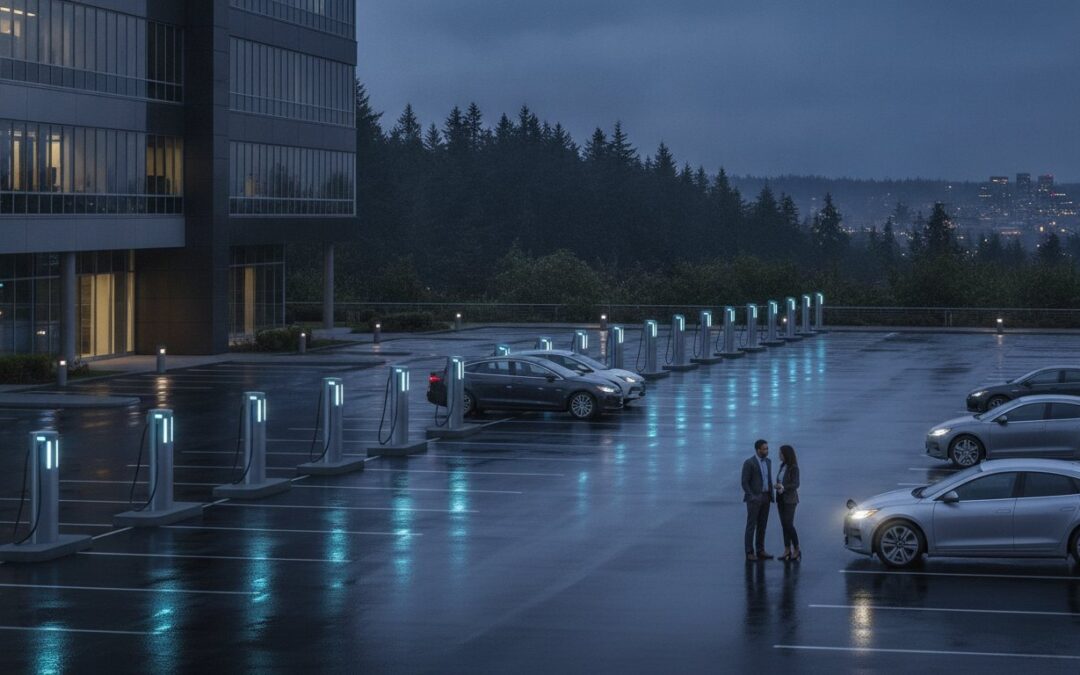
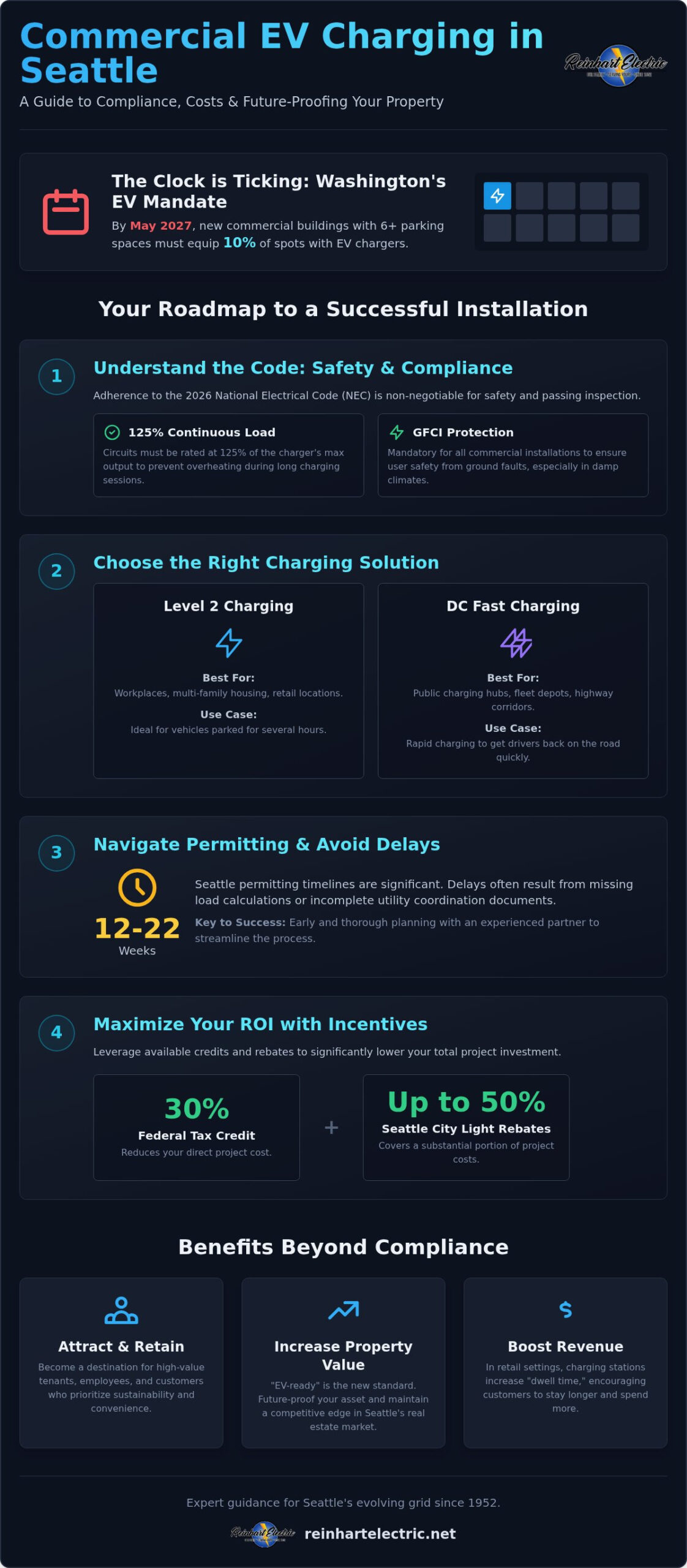
Did you know that by May 2027, the Washington State Building Code will require new commercial buildings with six or more parking spaces to have EV chargers at 10% of those spots? It’s a significant shift for local property owners. You likely feel the pressure of meeting these new mandates while worrying about whether your building’s older electrical panel can even handle the extra load. Dealing with Seattle City Light requirements and the high upfront costs of modern infrastructure can feel overwhelming.
We understand the stress of keeping a business compliant and profitable in an evolving city. This guide provides the expert clarity you need for a successful commercial EV charger installation Seattle project. We’ve seen our local grid evolve since 1952, and we’re here to help you navigate the 2026 National Electrical Code updates and permitting timelines that can stretch up to 22 weeks. You’ll learn how to maximize Seattle City Light incentives that cover up to 50% of project costs and how to attract high-value tenants with a seamless, safety-first charging setup. Let’s look at how to modernize your property without the typical headaches.
Key Takeaways
- Understand how the 2026 National Electrical Code and upcoming Washington building mandates impact your property’s parking requirements.
- Learn to leverage the 30% federal tax credit and local utility rebates to significantly lower your total project investment.
- Evaluate the differences between Level 2 and DC Fast Charging to choose the right solution for your specific business model and power capacity.
- Discover why a professional commercial EV charger installation Seattle project requires early coordination with utilities to avoid lengthy permitting delays.
- Identify necessary electrical panel upgrades to ensure your existing infrastructure safely supports modern high-demand charging equipment.
The Growing Demand for Commercial EV Charging in Seattle
Seattle isn’t just participating in the electric shift; it’s leading it. With a local grid powered largely by carbon-free energy, our city has become a hub for drivers who prioritize sustainability. National data showed plug-in electric vehicles accounted for about 9% of new passenger vehicle sales in 2025, but our local numbers often outpace the average. For business owners, this means the demand for reliable electric vehicle charging infrastructure has moved from a “nice-to-have” feature to a standard operational requirement.
Washington state’s commitment to zero-emission vehicles is firm. By 2035, all new passenger vehicles sold in the state must be zero-emission. This isn’t a distant goal; it’s a policy driving current purchasing decisions. This regulatory push, combined with high adoption rates in King County, directly impacts property values. Multi-family housing and commercial offices without charging options risk higher vacancy rates as tenants seek buildings that support their lifestyle. It’s about more than just a plug; it’s about maintaining the competitive edge of your real estate.
Attracting Top Talent and High-Value Customers
Seattle professionals often choose their workplace based on the availability of essential services. If an employee can’t charge their car during an eight-hour shift, they’ll likely look for an employer who offers that convenience. In retail settings, charging stations create “dwell time.” Customers who plug in tend to stay longer and spend more while their vehicle recovers range. By investing in a commercial EV charger installation Seattle business owners position themselves as forward-thinking leaders in the Pacific Northwest’s green economy. It builds trust with your clientele and shows you’re invested in the local community’s future.
Future-Proofing Your Seattle Commercial Property
Electrical infrastructure is always more affordable to install during a planned upgrade than as an emergency retrofit later. As we move through 2026, the Seattle real estate market expects buildings to be “EV ready” from the start. Starting your project now allows you to scale your network gradually as your fleet or tenant needs grow. We’ve helped local businesses manage their power capacity since 1952, ensuring that today’s installation doesn’t become tomorrow’s bottleneck. Planning for growth today prevents the need for costly, invasive construction in the future. It provides peace of mind knowing your building can handle the electrical demands of the next decade.
Navigating Seattle’s Commercial EV Infrastructure Requirements
Seattle’s regulatory environment is rigorous. If you’re planning a commercial EV charger installation Seattle property managers must adhere strictly to the 2026 National Electrical Code (NEC). Article 625 serves as the primary standard for these projects. It requires that circuits for EV equipment are rated at 125% of the maximum charger output. This “continuous load” rule is vital for safety; it prevents overheating during the long hours a vehicle might be plugged in. Additionally, all commercial installations now require Ground Fault Circuit Interrupter (GFCI) protection to ensure user safety in our damp Pacific Northwest climate.
Permitting and Inspections in King County
Navigating the permit desk at the Seattle Department of Construction and Inspections (SDCI) can be a test of patience. Current permitting timelines for commercial projects often range from 12 to 22 weeks. Delays usually happen when load calculations are missing or utility coordination isn’t documented. Because we’ve worked with King County inspectors since 1952, we know exactly what they’re looking for. We handle the paperwork and scheduling so you can focus on running your business. If you’re concerned about your current setup, we can perform electrical code updates and safety compliance checks to streamline the process.
Grid Capacity and Utility Coordination
Your building’s relationship with the grid depends on whether you’re served by Seattle City Light (SCL) or Puget Sound Energy (PSE). Both utilities have different requirements for transformer upgrades. A standard Level 2 charger might fit on your existing service, but a DC Fast Charger often requires a new 3-phase 480V service. We coordinate directly with SCL and PSE engineers to evaluate your building’s current capacity. If a service change is necessary, we manage the transition to ensure your power remains stable and your new infrastructure doesn’t overwhelm the local grid. Our goal is to make the utility coordination feel like a seamless part of the installation.
Choosing the Right Commercial Charging Solutions
Selecting the right hardware for your commercial EV charger installation Seattle project depends entirely on how your property is used. Level 2 chargers are the standard for workplaces and multi-family residential buildings where vehicles stay parked for several hours. These units provide a steady charge that’s easy on your building’s infrastructure. In contrast, DC Fast Charging (Level 3) is designed for high-turnover locations like retail centers or commercial fleets that need to return to the road quickly. While Level 2 is more common and cost-effective for most Seattle business owners, DC Fast Charging offers a premium service for customers who only have 20 to 30 minutes to spare.
Networked vs. Non-Networked Chargers
Networked chargers connect to the internet, allowing you to manage your stations remotely. This is essential if you plan to monetize your charging stalls by setting user fees for employees or the public. You can track energy usage in real-time and even integrate this data into your company’s annual sustainability reports. Non-networked chargers are simpler and often cheaper, but they lack the billing capabilities and remote monitoring that most facility managers need. If you want to recoup your investment through charging fees, a networked solution is the way to go.
Smart Load Balancing and Energy Management
Many older commercial buildings in Seattle have limited electrical capacity. Instead of paying for a massive service overhaul, you can use smart load balancing to maximize your existing panel. Load management is the strategic distribution of power to prevent system overloads. This technology allows multiple chargers to share a single circuit by dynamic load shedding. When several cars plug in at once, the system automatically adjusts the power flow to each vehicle. This prevents your building from hitting “peak demand” levels, which often lead to expensive surcharges on your monthly utility bill from Seattle City Light or PSE. If you’re worried about your current capacity, we specialize in electrical panel upgrades and service changes to ensure your property is ready for the future.
Maximizing ROI: Seattle Incentives, Rebates, and Planning
Investing in your property’s infrastructure is a significant decision, but the current financial landscape makes it more accessible than ever. For a commercial EV charger installation Seattle business owners can leverage federal tax credits that significantly offset the initial purchase and setup. The federal 30C tax credit provides up to 30% of the cost of purchasing and installing charging equipment, with a maximum credit of $100,000 per charger. When you combine this with Washington state’s focus on clean energy, the total cost of ownership becomes much more manageable for local enterprises.
Local utility programs offer some of the most direct financial support. Seattle City Light (SCL) provides incentives for workplace and fleet charging that can cover up to 50% of total project costs, capped at $25,000 per site. If your business is located in a designated disadvantaged community, these incentives can increase to cover 100% of costs, up to $50,000. For those looking at high-output solutions, SCL’s DC Fast Charger incentives can reach up to $200,000 per site. Understanding these tiers is vital for planning a project that pays for itself through increased property value and tenant retention.
How to Qualify for Local Utility Rebates
Securing these funds requires a methodical approach. First, you must obtain pre-approval from SCL or PSE before any work begins; starting without this step often disqualifies the project. Second, you must choose hardware from a “qualified” list that meets specific utility standards for connectivity and efficiency. Finally, after the installation is complete, you’ll need to submit detailed documentation and pass a final inspection. We’ve helped many neighbors navigate these requirements to ensure they don’t leave money on the table. If you’re ready to start your application, our team can guide you through the technical requirements for a commercial EV charger installation that meets every rebate standard.
Long-Term Operational Savings
Since 1952, we’ve watched Seattle grow from a quiet port city into a global tech hub. This history matters for your 2026 project. We aren’t a new startup chasing a trend; we’re a family-owned business deeply rooted in the Pacific Northwest. When you choose us for your commercial EV charger installation Seattle project, you’re partnering with a team that understands the literal foundation of our city’s power grid. We’ve spent decades navigating King County codes and building relationships with local inspectors. This local accountability ensures your project is done right the first time. We call this the “Reinhart Standard.” It’s built on safety-first practices, transparent pricing, and a commitment to neighborly service that treats your property like our own.
Expertise in Aging Infrastructure
Many of Seattle’s most iconic commercial properties were built long before electric vehicles existed. These historic buildings often require a delicate touch and technical precision to modernize. We specialize in identifying the unique challenges of older infrastructure, such as limited panel space or outdated wiring. By conducting thorough initial site assessments, we help you avoid the “hidden costs” that often surprise property owners mid-project. We don’t just guess at your capacity; we measure it with precision. If your building needs more power to support a new charging network, we provide expert Electrical Panel Upgrades King County services to ensure your system is safe and code-compliant. This proactive approach reduces anxiety and ensures your project stays on schedule.
Your Local Partner for the Long Haul
Our commitment to your business doesn’t end when the last charger is bolted down. We believe in being a steady hand for the long term. Reliable charging is vital for tenant satisfaction and customer loyalty, so we offer customized maintenance plans to ensure 99% uptime for your equipment. If a station goes down or an electrical issue arises at an inconvenient hour, our 24/7 emergency support team is ready to respond. We serve the entire region, from downtown Seattle to Renton, Kent, and Auburn. We treat every task with the same level of care, regardless of its scale. You can trust us to keep your infrastructure running smoothly so you can focus on your core business. We’re here to be your partner in maintaining a safe, modern environment for your clients and staff. Contact Reinhart Electric today to schedule your commercial site assessment.
Preparing Your Business for Seattle’s Electric Future
Modernizing your building to support electric vehicles is a strategic move for your property’s long-term value and tenant satisfaction. By navigating the 2026 National Electrical Code requirements and leveraging generous utility rebates, you can transform a regulatory mandate into a competitive advantage. A successful commercial EV charger installation Seattle project depends on precise planning and a thorough understanding of our local grid capacity. You don’t have to face these technical complexities alone when you have a neighborly expert by your side.
Reinhart Electric has been a steady, family-owned partner for local business owners since 1952. Our team of fully licensed and bonded electricians ensures your infrastructure is safe, efficient, and built to last for generations. We take pride in our local roots and provide the peace of mind that comes from decades of experience and 24/7 emergency service availability. Schedule Your Commercial EV Site Assessment with Reinhart Electric today to begin your transition. Your property’s future is bright, and we’re honored to help you power it with confidence and reliability.
Frequently Asked Questions
How much does commercial EV charger installation cost in Seattle?
The total investment for your project depends on several factors, including your building’s current electrical capacity and the distance from your panel to the parking stalls. Site work like trenching or concrete restoration in cities like Kent or Auburn also plays a major role in the final cost. We focus on providing right-sized solutions that meet your specific needs without adding unnecessary expenses. Our team ensures every installation is code-compliant and safe.
Does Seattle City Light offer rebates for commercial EV chargers?
Seattle City Light provides robust rebate programs that can significantly offset your project costs. Many businesses qualify for incentives that cover up to 50% of the total installation, while projects in disadvantaged communities may receive up to 100% coverage. These funds are designed to support workplace charging and fleet electrification throughout the city. It’s critical to secure pre-approval before starting your project to ensure you remain eligible for these local utility savings.
How long does the permitting process take for commercial EV chargers in King County?
Permitting for commercial electrical projects in King County generally takes between 12 and 22 weeks. This timeline varies based on the specific requirements of the Seattle Department of Construction and Inspections or local offices in Renton and Kent. Coordination with utilities like Puget Sound Energy for service upgrades can also extend the process. We manage all the necessary paperwork and inspections to help your business avoid the common errors that often lead to frustrating delays.
What is the difference between Level 2 and DC Fast Charging for my business?
Level 2 chargers are the most common choice for workplaces and apartment buildings in Tukwila where cars stay parked for several hours. They use 240V power and provide a steady, reliable charge. DC Fast Charging, or Level 3, is designed for rapid turnover in retail settings or for commercial fleets. These units can charge a vehicle in under 30 minutes but require significantly more power and infrastructure. We help you choose the model that fits your goals.
Can my older commercial building handle multiple EV charging stations?
Most older buildings can handle EV charging, but they often require an initial load calculation to ensure the system isn’t overwhelmed. Many historic properties in Seattle were not built with the capacity for modern high-amperage equipment. We specialize in evaluating aging infrastructure to determine if a panel upgrade or smart load management is necessary. These solutions allow you to support multiple stations safely while maintaining the electrical integrity of your property for tenants and staff.
Do I need a networked charger for my apartment building in Renton?
Networked chargers are essential for multi-family properties in Renton and Burien if you plan to bill tenants for their energy use. These systems connect to the internet, allowing you to track individual usage and set automated fees. Non-networked chargers are simple plug-and-play devices that don’t offer billing or remote monitoring capabilities. For most apartment owners, a networked system provides the necessary data and control to turn your charging infrastructure into a manageable and sustainable building asset.
Is there a tax credit for commercial EV charging stations in 2026?
The federal 30C tax credit is a major benefit for commercial EV charger installation Seattle projects in 2026. This incentive allows businesses to claim up to 30% of their hardware and installation costs, with a maximum credit of $100,000 per charger. Washington state also provides sales tax exemptions for certain charging equipment to encourage local adoption. These financial tools make it much easier for property owners to invest in the infrastructure needed to attract eco-conscious customers and high-value tenants.
What maintenance is required for commercial EV charging stations?
Routine maintenance for commercial stations involves regular cable inspections and cleaning of the charging connectors to ensure a safe connection. In our damp Pacific Northwest climate, it’s also important to check for signs of moisture or corrosion within the unit. Networked chargers may require software updates to keep billing systems and security features running smoothly. We offer maintenance plans for businesses in Auburn and Covington to ensure your chargers stay reliable and provide a great experience for your users.