
With over 20% of new vehicle titles in Washington now belonging to electric cars, your parking lot is quickly becoming a critical piece of your business infrastructure. As more employees and customers make the switch, the demand for commercial EV charger installation Seattle businesses can rely on has never been higher. You know that adding charging stations is a smart move for the future, but the path from planning to a powered-up port often feels buried under city red tape and technical hurdles.
It’s frustrating to face complex Seattle City Light requirements or worry if your older building’s electrical panel can even handle the load. We understand that you need a solution that works without the headache of permitting delays or code violations. This guide will help you secure your ROI by explaining the 2026 NEC standards and showing you how to access local utility rebates that can cover up to 100% of project costs for eligible sites. You’ll learn how a methodical, safety-first approach ensures your installation meets the latest Washington State Building Code updates while providing reliable power for years to come.
Key Takeaways
- Learn how a strategic commercial EV charger installation Seattle plan can increase your property value and help you attract high-value employees who drive electric vehicles.
- Understand the technical differences between Level 2 and DC Fast Charging to choose the right infrastructure for your specific business needs.
- Navigate the complexities of the 2026 National Electrical Code and Seattle permitting requirements to ensure your project stays on schedule and meets all safety standards.
- Discover how to maximize your ROI by stacking local Seattle City Light incentives with federal tax credits to significantly reduce your total project costs.
- Find out why assessing your building’s electrical panel capacity is the first step toward a reliable, turn-key installation that avoids future power issues.
Why Commercial EV Charging is a Strategic Move for Seattle Businesses
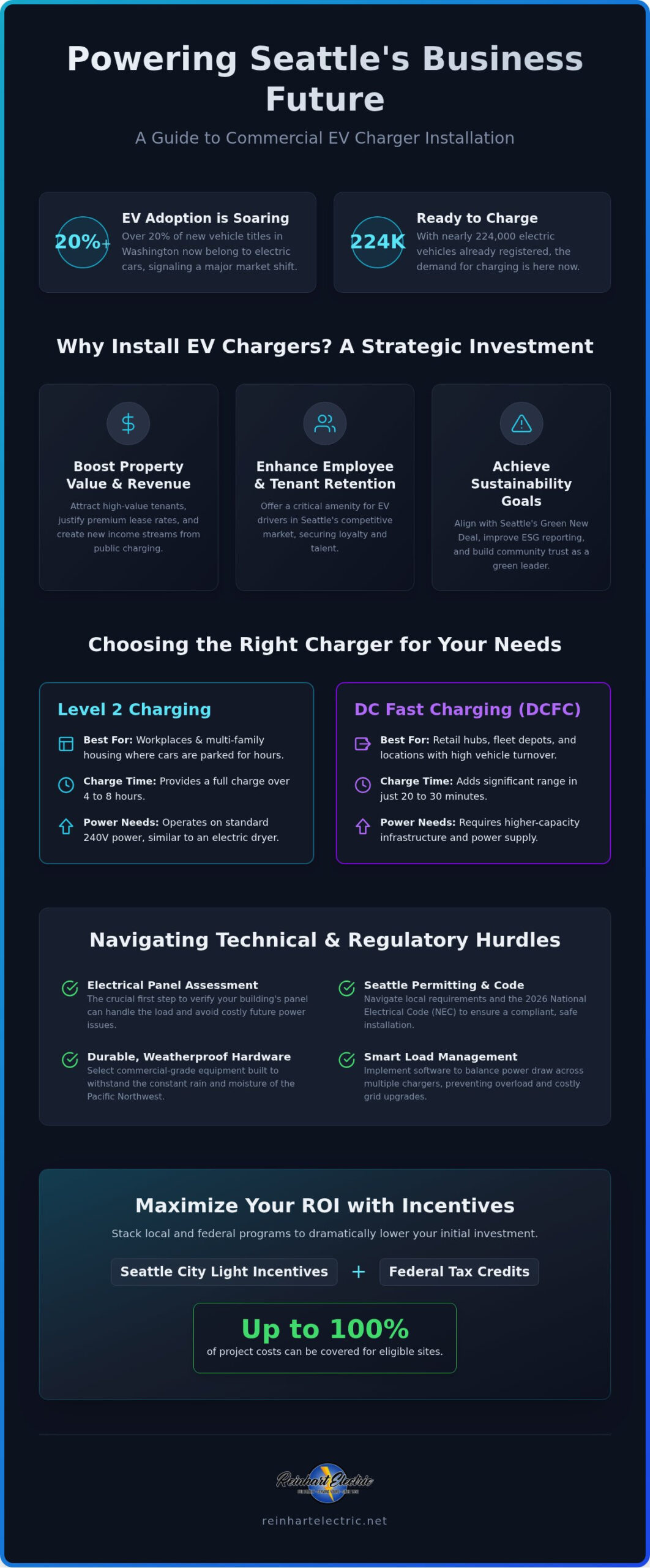
Investing in a commercial EV charger installation Seattle project is a forward-thinking move that goes far beyond simple utility. It’s an investment in your building’s long-term viability. Our family has served local businesses since 1952, and we have seen how technical adaptability defines success in this city. Today, providing power for electric vehicles is the new standard for modern commercial infrastructure. With nearly 224,000 electric vehicles already registered in Washington, the window for being an early adopter is closing quickly.
Adding these stations significantly boosts property value across King County. Commercial real estate with integrated charging infrastructure attracts higher-quality tenants and often allows for premium lease rates. You can also look at these installations as a new revenue stream. By setting up paid public charging, you can offset installation costs while providing a valuable service to the neighborhood. This turns a stagnant parking lot into an active asset that pays for itself over time through consistent use.
Employee and Tenant Retention in the Seattle Market
For businesses in the tech-heavy Seattle market, EV charging is now a core requirement for Class A office spaces. Employees who commute in electric vehicles need the peace of mind that comes with workplace charging. If they can’t plug in at your office, they may look for a workplace that supports their lifestyle. This applies to multi-family residential buildings too. Long-term tenants prioritize properties with reliable Level 2 charging. A clear understanding EV charging technology allows you to install the right hardware to keep these tenants happy without compromising your building’s electrical integrity.
Sustainability Goals and Corporate Responsibility
Seattle’s Green New Deal and Washington’s Clean Cars 2030 law have set a clear path for our state. Businesses that act now to align with these electrification targets avoid the rush and potential higher costs of later mandates. Moving toward a greener footprint also strengthens your ESG reporting, which is increasingly important to investors and clients alike. Positioning your brand as a leader in the local clean energy transition builds a level of community trust that marketing alone cannot buy. We treat every commercial EV charger installation Seattle project with the methodical care required to ensure your business stays compliant and safe as our city evolves.
Technical Requirements for Commercial EV Charging in Seattle
Designing a system for commercial EV charger installation Seattle requires more than just picking a plug. You must account for the specific electrical environment of your building. Seattle is home to many beautiful, historic commercial properties, but their electrical systems often aren’t ready for the high-amperage demands of modern charging. We take a methodical approach to ensure your infrastructure is safe and reliable for the long haul.
Durability is non-negotiable in the Pacific Northwest. Our constant rain and moisture can take a toll on outdoor electrical components. We prioritize commercial-grade, weatherproofed equipment that stands up to the elements. Beyond the hardware itself, smart load management technology plays a vital role. This software balances the power draw across multiple ports. This often prevents the need for expensive grid-level upgrades while keeping your building’s primary systems running smoothly.
Level 2 vs. DC Fast Charging: Which fits your business?
The right charger depends entirely on how long your visitors stay. Level 2 stations are the standard for workplaces and multi-family housing. They operate on 240V power and provide a full charge over four to eight hours. If you operate a retail hub or a fleet depot where turnover is fast, DC Fast Charging (DCFC) is the better choice. While DCFC units have higher hardware and power requirements, they provide significant range in just 20 to 30 minutes. You can explore various Washington State commercial EV charging incentives to help bridge the gap between these two options.
Electrical Infrastructure and Panel Upgrades
Older Seattle buildings frequently have panels that are already near capacity. Adding a single Level 2 charger can draw 40 amps or more. This makes an electrical panel upgrade a common and necessary part of the process. We calculate the total load for every port, ensuring your transformers and dedicated circuits handle the peak demand safely. This step is critical for meeting the 2026 National Electrical Code (NEC) standards. If your building’s system is dated, we focus on troubleshooting and upgrading your service change to provide a steady hand for your electrification project.
Navigating Seattle Permitting and Electrical Code Requirements
The city’s red tape doesn’t have to stop your progress. Getting a permit through the Seattle Department of Construction & Inspections (SDCI) can feel like a daunting task, but it is a necessary step to ensure your system is safe and legal. We have been working with city officials since 1952, so we know how to move these applications forward without unnecessary delays. A successful commercial EV charger installation Seattle depends on precise site plans and accurate load calculations from the very start. If your paperwork isn’t perfect, the city will send it back, which pushes your timeline out by weeks.
Compliance with the 2026 National Electrical Code (NEC) Article 625 is the standard for every project we handle. This code governs the wiring, protection, and equipment used for electric vehicle supply. Following these rules isn’t just about passing an inspection; it’s about protecting your property from electrical fires and equipment failure. Our methodical approach ensures that every circuit and connection meets these rigorous safety standards before we ever flip the switch.
The Seattle Permitting Roadmap
We handle the heavy lifting of the permitting process so you can focus on running your business. The journey typically follows these three stages:
- Initial Site Assessment: We perform a detailed load calculation to ensure your existing service can handle the new demand.
- Permit Submission: We submit the electrical permit applications to the City of Seattle. In our experience, permit fees for these projects usually range from $240 to $365.
- Post-Installation Inspection: Once the work is complete, a city inspector will verify the installation. We then coordinate with Seattle City Light for the final interconnection.
Accessibility and Zoning Compliance
Accessibility is a critical part of commercial charging. Publicly accessible chargers must comply with the Americans with Disabilities Act (ADA). This means your charging stalls need specific reach ranges and clear floor space so everyone can use them safely. Washington State also has specific requirements for “EV-ready” parking spaces in new developments. We help you navigate these zoning laws and ensure your signage and dedicated parking spots meet all local regulations. This attention to detail prevents future legal headaches and makes your business more welcoming to all customers. If your project involves public works, we also ensure compliance with Senate Bill 5528, which requires specific certifications for installers on public projects as of 2026.
Maximizing ROI: Incentives and Grants for Seattle Commercial Installs
The upfront cost of a commercial EV charger installation Seattle project is often the biggest hurdle for business owners. However, the financial landscape in 2026 is designed to reward those who make the switch early. By “stacking” federal, state, and local incentives, many Seattle businesses can offset a massive portion of their initial investment. We have helped our neighbors navigate these programs for decades, and we know that a methodical approach to paperwork is just as important as the electrical work itself. Understanding how to combine these credits is the key to achieving a faster payback period.
Calculating your return on investment involves more than just looking at the installation price. You should also consider the secondary revenue from public charging. Seattle City Light currently charges $0.21 per kWh for its public Level 2 chargers. By setting similar rates for your own publicly accessible ports, your infrastructure can eventually pay for itself through consistent daily use. When you combine this with the increased property value and employee retention mentioned earlier, the long-term financial benefits become clear.
Local Utility Rebates and Programs
Seattle City Light’s Business EV Charging Program remains one of the most robust in the country. For eligible Tier 2 businesses, such as small or minority-owned enterprises, incentives can reach up to $50,000 for hardwired Level 2 chargers. If your site requires DC fast chargers, that incentive can climb as high as $200,000. These funds are often limited and distributed on a first-come, first-served basis. It’s vital to time your application correctly and ensure your site plan meets all utility specifications before you begin. Multi-family property owners in King County also have access to specific programs designed to bring reliable charging to apartment complexes and condos.
Federal and State Tax Advantages
On the federal level, the Section 30C Alternative Fuel Infrastructure Tax Credit is a powerful tool for ROI. This credit covers 30% of the cost of your charging equipment and installation, up to $100,000 per port for commercial sites. To qualify for the full amount, you must meet specific prevailing wage and apprenticeship requirements, which is why working with a seasoned professional team is essential. While some state-level vehicle purchase exemptions expired in 2025, the 2026 focus has shifted toward infrastructure grants like the Washington Zero-Emission Incentive Program (WAZIP), which provides over $110 million for commercial electrification. If you’re ready to see how these numbers apply to your property, contact our team for a detailed project assessment.
Partnering with Reinhart Electric & Service, Inc. for Seamless Commercial Installation
Choosing a partner for your commercial EV charger installation Seattle project is about more than just finding an electrician. It’s about finding a team that understands the history of our city’s infrastructure. Reinhart Electric & Service, Inc. has been a family-owned and operated business since 1952. This deep local history gives us a unique perspective on the challenges older Seattle buildings face. We don’t just install equipment; we build long-term relationships based on honesty and hard work. Our goal is to provide you with peace of mind through a methodical approach to every technical task, regardless of scale.
We live and work in the same communities we serve. This local connection means we’re personally invested in the safety and reliability of your electrical infrastructure. Whether you’re managing a tech campus in South Lake Union or a retail center in Ballard, we provide customized solutions that fit your specific site. We handle everything from initial load assessments to final utility interconnections with a focus on transparency. You’ll always know exactly where your project stands and what to expect next.
The Reinhart Difference: A Legacy of Trust
Our family-owned approach ensures that you aren’t just another ticket in a system. You get direct communication and a team that takes pride in its reputation for stability. Reinhart Electric & Service, Inc. has spent decades working with the specific building codes and utility requirements of the Seattle area. This experience allows us to anticipate potential hurdles with local providers before they become delays. We understand that your commercial chargers need to be 100% reliable for your employees and customers. We treat your safety as our own priority, ensuring every connection meets the highest professional standards.
Get Started with a Professional Site Audit
The first step toward a successful installation is a thorough professional audit. During our initial commercial consultation, we walk your property to assess your current electrical panel capacity and identify the best locations for your charging ports. We look for the most efficient path for conduit and wiring to keep your costs manageable while respecting the architectural integrity of your building. After the audit, we provide a clear, itemized quote. There are no hidden fees or high-pressure sales tactics here. We simply offer the facts you need to make an informed decision for your business. Contact Reinhart Electric & Service, Inc. today for your commercial EV charger consultation and let our steady hand guide your project to completion.
Powering Your Business for a Sustainable Future
Seattle is moving toward an electric future. Acting now positions your business as a leader in this energy transition. You’ve seen how a strategic commercial EV charger installation Seattle project can improve employee retention and boost property value while meeting the latest regulatory standards. By leveraging the available local and federal incentives we discussed, you can secure a faster return on your capital. It’s a practical way to future-proof your infrastructure while supporting the local clean energy movement.
Reinhart Electric & Service, Inc. has served this community since 1952. As licensed, bonded, and insured experts with an A+ rating from the BBB, we provide the steady hand needed to navigate complex grid requirements and city permitting. We treat every commercial project with the methodical care it deserves to ensure your system remains safe and reliable for years to come. Our team is here to handle the technical details so you can focus on your daily operations without the stress of infrastructure hurdles.
Ready to take the next step? Schedule your Seattle commercial EV charger consultation with Reinhart Electric & Service, Inc. We look forward to helping you power the next chapter of your business with confidence and clarity.
Frequently Asked Questions
How much power does a commercial Level 2 charger require?
A commercial Level 2 charger typically requires a dedicated 240-volt circuit with a capacity of 40 to 80 amps. This setup provides between 7.2 kW and 19.2 kW of power depending on the specific hardware you choose. We perform a precise load calculation to ensure your building’s infrastructure can support this continuous draw without tripping breakers or overheating wires.
What is the typical timeline for a commercial EV charger installation in Seattle?
The timeline for a commercial EV charger installation Seattle project generally ranges from eight to sixteen weeks. This duration accounts for the initial site audit, professional load studies, and the Seattle Department of Construction & Inspections (SDCI) permitting process. If your project requires a transformer upgrade from Seattle City Light, the timeline can extend further due to utility coordination requirements.
Are there specific ADA requirements for EV charging stations in Washington?
Yes, Washington State requires that publicly accessible charging stations comply with the Americans with Disabilities Act (ADA) standards. These regulations dictate the height of the charger’s operable parts and the amount of clear floor space around the unit. We help you design your parking layout to ensure at least one stall meets these accessibility rules, including proper reach ranges and path-of-travel requirements.
Can my existing electrical panel handle multiple EV chargers?
Whether your current panel can handle multiple chargers depends on its total amperage and your building’s existing electrical load. Many older commercial properties in Seattle have panels that are already near capacity. We conduct a thorough assessment to determine if you need a panel upgrade or if a smart load management system can balance the power draw across multiple ports safely.
Does Seattle City Light offer rebates for commercial EV charging?
Seattle City Light provides robust incentives through its Business EV Charging Program. These rebates can cover a significant portion of the costs for Level 2 chargers and DC fast chargers at eligible commercial sites. We stay updated on the latest 2026 funding tiers to help you maximize these savings and ensure your application meets all utility technical specifications.
What is the difference between networked and non-networked commercial chargers?
Networked chargers connect to the internet, allowing you to monitor usage, manage access, and bill users for the electricity they consume. This is the best choice for retail sites or multi-family properties. Non-networked chargers are simpler devices that provide power without data tracking. They’re often used in private fleet lots where billing and remote monitoring aren’t necessary.
How do I manage electricity costs for employee or tenant charging?
The most effective way to manage energy costs is through networked charging software that allows you to set pricing or access schedules. You can also take advantage of Seattle City Light’s time-of-use rates by encouraging charging during off-peak hours. These tools ensure that you can recover your utility expenses while providing a reliable amenity to your staff or residents.
Why should I choose a local Seattle electrician over a national provider?
A local electrician brings deep knowledge of Seattle’s specific building codes and established relationships with city inspectors and utility providers. National companies often use rotating subcontractors, which can lead to inconsistent quality and slower response times. We’ve served the Seattle community since 1952, offering the stability and neighborly accountability that national firms simply can’t match.