
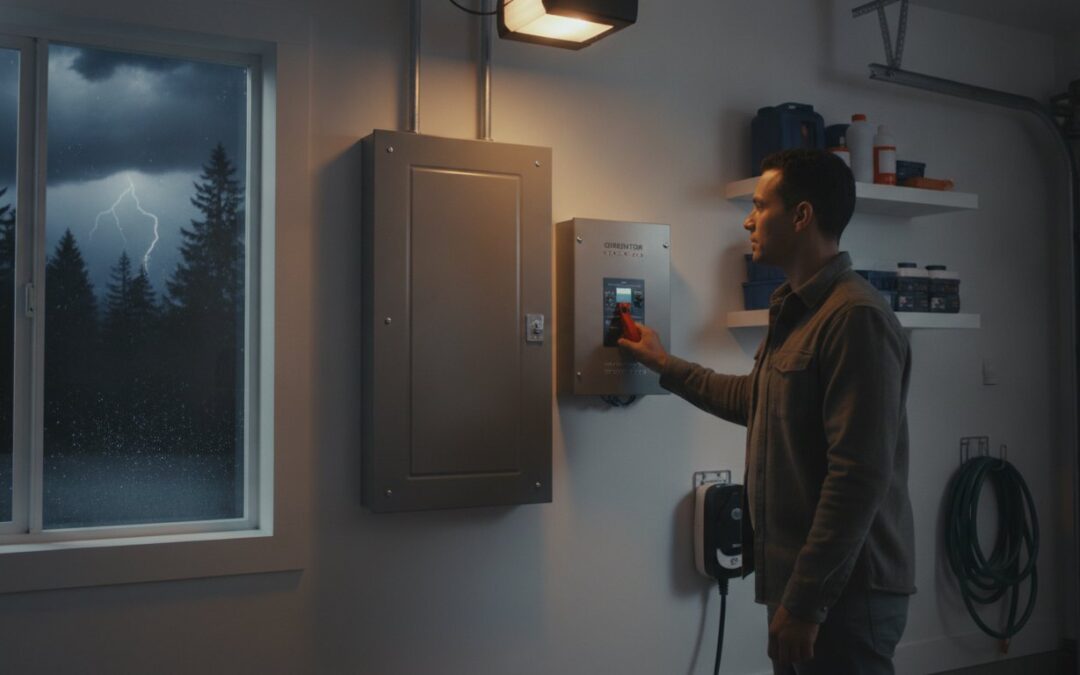
Imagine the wind howling off Puget Sound as the lights flicker and then go dark. You have a portable generator ready in the garage, but the thought of connecting it to your home’s panel feels like a high-stakes guessing game. It’s natural to worry about the dangers of backfeeding or the confusion of complex wiring. This is why professional manual transfer switch installation in Seattle is the most reliable way to protect your family and your electrical system during our unpredictable storm seasons.
We know you just want to keep the furnace running and the lights on without risking a code violation or a safety hazard. You’re likely looking for clarity on the choice between a dedicated transfer switch and a simple interlock kit. This guide will clarify those differences and provide a clear path toward a code-compliant backup power setup. You’ll learn exactly how these systems work to keep your hard-wired appliances running, giving you the confidence to handle the next blackout with total peace of mind.
Key Takeaways
- Learn why avoiding “backfeeding” is essential for protecting your home and the utility workers restoring power to your neighborhood.
- Compare the benefits of manual transfer switches versus interlock kits to see which solution fits your electrical panel best.
- Discover how professional manual transfer switch installation in Seattle lets you safely run hard-wired appliances like your gas furnace’s blower motor.
- Find out how to create a “wattage budget” so your portable generator handles your most critical circuits without any risk of overloading.
- Get an inside look at the local permitting and site audit process required to keep your backup power system fully compliant with current codes.
Why Seattle Homeowners Need a Manual Transfer Switch for Storm Season
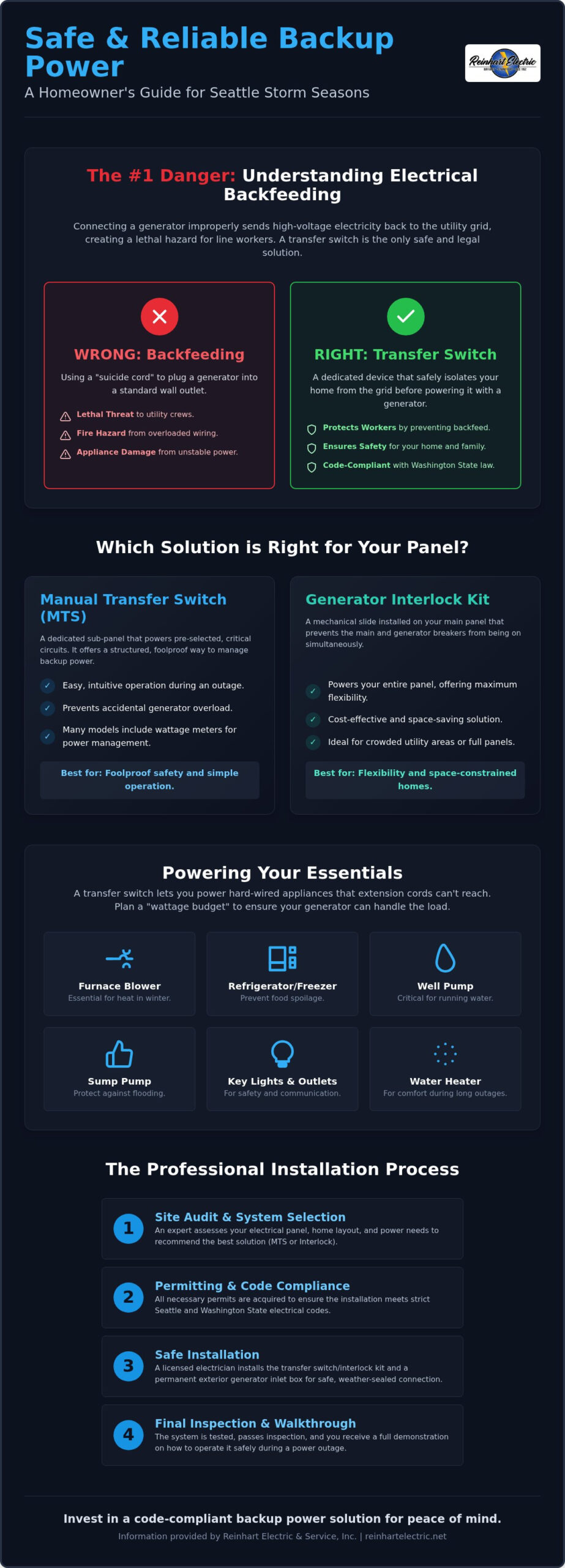
A transfer switch is a specialized electrical sub-panel that creates a safe, permanent bridge between your portable generator and your home’s main wiring. During a blackout, it allows you to flip a switch and toggle power from the utility grid to your generator. This is the only legal and safe way to handle manual transfer switch installation Seattle homeowners should consider. Without it, many people resort to “backfeeding,” which involves using a dangerous “suicide cord” to plug a generator into a standard wall outlet.
Backfeeding sends high-voltage electricity back into the neighborhood power lines. It’s a lethal threat to Seattle City Light and Puget Sound Energy (PSE) crews who are working to restore your power. Washington State electrical codes are strict about this. You must have a physical disconnect that prevents the generator and the utility from being connected at the same time. This keeps your home isolated and the utility workers safe.
The Risks of Improper Generator Connection
Running extension cords through windows or doors isn’t just a trip hazard. It’s a security risk and a major fire hazard. Cords can overheat or get pinched, leading to sparks. Even worse, cracked doors often lead to carbon monoxide buildup if the generator is too close to an opening. A professional installation includes a permanent exterior inlet box. This keeps the exhaust outside and your home’s envelope sealed. Beyond safety, improper connections can fry sensitive electronics. A dedicated switch ensures a stable connection that protects your modern appliances from destructive surges and erratic voltage.
Seattle Weather Patterns and Outage Preparedness
November windstorms are a reality of life in the Pacific Northwest. When trees fall and the grid goes down, your gas furnace won’t help you if the electrical blower motor can’t start. Since these systems are hard-wired, you can’t just plug them into an extension cord. A manual transfer switch is the only way to power your furnace, well pump, or water heater during an extended outage. Investing in manual transfer switch installation Seattle doesn’t just prepare you for “The Big One.” It also adds tangible resale value to King County homes. Local buyers prioritize properties with reliable, code-compliant backup power solutions already in place.
Manual Transfer Switches vs. Interlock Kits: Which is Right for Your Panel?
Choosing the right backup power hardware depends on your specific home and your comfort level with electrical management. While both options provide a safe disconnect from the utility grid, they function very differently. For many homeowners, manual transfer switch installation Seattle services provide the most structured and foolproof way to manage power during a blackout. Others might prefer the simplicity and lower profile of a generator interlock kit. Understanding these mechanical differences helps you make a choice that fits both your budget and your family’s needs.
Deep Dive into Manual Transfer Switches
A manual transfer switch (MTS) acts as a dedicated sub-panel for your home. During the installation, we move your most important circuits, such as the furnace, refrigerator, and well pump, into this separate box. This setup is incredibly easy to use when the lights go out. You simply flip a toggle on the transfer panel to move those circuits from utility power to generator power. Because the circuits are pre-selected, you don’t have to worry about accidentally overloading your generator by turning on too many appliances at once. Many models also include built-in wattage meters. These allow you to see exactly how much power you’re drawing in real-time, which is helpful for managing fuel consumption during long outages.
Understanding Generator Interlock Kits
A generator interlock kit is a mechanical slide that attaches directly to your existing main service panel. It physically prevents the main breaker and the generator breaker from being turned on at the same time. This is a very cost-effective solution that offers maximum flexibility. Since it powers your whole panel, you can choose to turn on any circuit in the house, provided you stay within your generator’s wattage capacity. These kits are an excellent choice for crowded panels in Renton homes where there isn’t enough wall space for a secondary sub-panel. It’s a clean, space-saving way to achieve code compliance without adding extra boxes to your utility room.
Seattle’s housing stock varies from mid-century moderns to classic Craftsman homes. This means electrical panels come in all shapes, sizes, and ages. Some older panels aren’t compatible with modern interlock slides, making a dedicated transfer switch the only safe path forward. If you’re unsure which setup is right for your specific equipment, our team can perform a comprehensive safety audit to evaluate your existing panel and generator needs. We’ll ensure your manual transfer switch installation Seattle project is tailored to your home’s unique layout and power requirements.
Selecting Critical Circuits: What to Power During a Puget Sound Outage
Most portable generators aren’t designed to run your entire home at once. You have to be selective about where that energy goes. This is why manual transfer switch installation Seattle is so effective; it allows you to pre-program your “must-have” circuits before a storm even hits. By creating a “wattage budget,” you ensure your generator stays within its limits while keeping your family comfortable and safe.
Even if you have a gas furnace, you won’t have heat without electricity. The blower motor that pushes warm air through your vents is electric and hard-wired into your panel. In our wet, chilly winters, keeping that motor running is the difference between a cozy home and a pipe-bursting emergency. It’s almost always the first circuit we recommend for any transfer switch setup.
A standard refrigerator usually pulls about 600 to 800 running watts. Adding this to your transfer switch prevents hundreds of dollars in food spoilage during an extended outage. If you have a deep freezer in the garage, that should be your next priority. These appliances don’t run constantly, so they are easy to manage within a standard power budget.
If you live in more rural parts of King County, you likely rely on a well pump or a sump pump. These are heavy-duty, hard-wired devices that require a transfer switch to operate. Keeping your water flowing and your basement dry are essential safety needs that extension cords simply can’t handle.
Calculating Your Power Needs
You need to understand the difference between running watts and starting watts. Appliances with motors, like your refrigerator or furnace blower, need a massive “kick” of energy to get moving. Surge wattage is the temporary peak power an appliance requires to start its motor before settling into its continuous running state. If you don’t account for this burst, you’ll trip the breaker on your generator the moment the fridge kicks on.
- Gas Furnace Blower: 600 to 1,000 watts
- Refrigerator/Freezer: 600 to 800 watts
- Well Pump (1/2 HP): 1,000 to 2,000 watts
- LED Light Circuit: 100 to 200 watts
- Sump Pump: 800 to 1,500 watts
Modern Essentials: Home Offices and Connectivity
Seattle is a tech hub, and many of us work from home. Keeping your router and modem on a dedicated circuit is now a necessity. If you use sensitive laptops or high-end monitors, consider an inverter generator. These provide “clean power” with low total harmonic distortion, which prevents damage to delicate circuitry. Finally, prioritize your LED lighting circuits. Since LEDs draw very little power, you can light up multiple rooms without eating into your wattage budget. This leaves more room for the heavy hitters like your well pump or furnace motor. Professional manual transfer switch installation Seattle ensures these sensitive modern needs are met without compromising the safety of your home’s electrical system.
The Professional Installation Process and Seattle Electrical Codes
Professional manual transfer switch installation Seattle homeowners choose follows a methodical, safety-first workflow. It begins with a thorough site audit. We look at your existing electrical panel, noting its age and capacity. This is especially important in Seattle’s historic neighborhoods where older panels might require specific handling before adding backup systems. We also determine the best path for the wiring to reach your generator’s outdoor staging area. This ensures the connection is both efficient and aesthetically clean.
Once the plan is set, we handle the paperwork. Navigating the requirements of the Seattle Department of Construction and Inspections (SDCI) or King County’s permitting office can be complex. We ensure every component meets the 2024 Seattle Electrical Code and the 2023 National Electrical Code (NEC) standards currently used in Washington. After permits are secured, we mount the transfer switch near your main panel and install the exterior power inlet box. Finally, we move your critical circuits to the new switch and perform a live load test to ensure everything functions perfectly during a real outage.
Navigating Local Permits and Inspections
Attempting a DIY installation to save money often backfires. In Washington State, unpermitted electrical work can lead to your home insurance company denying claims if a fire occurs. When an L&I or city inspector visits, they look for specific safety features like the “UL Listed” label on all equipment. This label proves the hardware has been tested for safety and reliability. A professional install provides the documentation you need to prove your home is safe, compliant, and ready for any season. It’s about protecting your investment as much as your family.
Placement of the Power Inlet Box
The power inlet box is the permanent connection point on the outside of your home. Safety is our top priority here. We follow strict codes regarding the distance between your generator’s exhaust and any windows, doors, or vents. This prevents carbon monoxide from seeping into your living space. We choose a weather-resistant location that stays accessible even during a heavy November downpour. This “plug and play” setup means you can have your generator connected and running in under 60 seconds. You don’t have to leave doors or windows cracked to run messy cords anymore.
Ready to secure your home’s power before the next storm hits? Contact us today to schedule your professional generator switch installation and ensure your system meets all local safety codes.
Reliable Backup Power Solutions with Reinhart Electric & Service, Inc.
Since 1952, Reinhart Electric & Service, Inc. has stood as a pillar of reliability for homeowners across the Puget Sound. Our family-owned and operated business is now in its third generation of service. We’ve spent over seven decades learning the unique electrical quirks of Seattle’s diverse housing stock. When you choose us for manual transfer switch installation Seattle, you aren’t just hiring a contractor. You’re partnering with neighbors who understand the importance of a safe, warm home during a winter storm.
National chains often rely on high-pressure sales and rapid-fire installations. We take a different path. Our team prioritizes personalized safety audits that look beyond the immediate task. We examine your entire system to ensure your backup power setup is perfectly integrated and code-compliant. This transparent approach reduces anxiety and builds the trust necessary for a long-term relationship. We believe in service above all, treating every project with the methodical care it deserves.
Why Seattle Trusts Reinhart Electric & Service, Inc.
Our deep roots in the community give us a unique advantage. We are intimately familiar with the various housing vintages found in Auburn, Kent, and Burien. Whether you have a classic mid-century panel or a modern high-capacity system, we know exactly how to integrate a transfer switch safely. Our commitment doesn’t end when the sun goes down or the business day finishes. We offer 24/7 emergency service because we know that electrical issues don’t follow a schedule. If the lights go out, we are ready to help. We also provide detailed training for every client. We don’t just install the hardware; we walk you through the entire connection process until you feel completely confident using it.
Get Started with Your Generator Setup
Preparing for storm season starts with a simple conversation. When you call for your initial consultation, it’s helpful to have your current electrical panel’s brand and your generator’s model number ready. This allows us to provide more accurate guidance from the very first minute. Many of our clients also choose to combine their manual transfer switch installation Seattle with a whole-house surge protection upgrade. This dual approach protects your home from both utility grid spikes and the erratic voltage that can sometimes occur during generator startup. It’s an efficient way to achieve total peace of mind for your family’s safety.
Secure Your Home Before the Next Storm Hits
Preparing for Seattle’s unpredictable storm season is about more than just owning a generator. It’s about ensuring your family stays warm and your home’s electrical system remains protected. By investing in professional manual transfer switch installation Seattle, you eliminate the risks of dangerous backfeeding and messy extension cords. You gain the ability to power your furnace blower and well pump with the simple flip of a switch, keeping your household running smoothly while the neighborhood waits for the grid to return.
Reinhart Electric & Service, Inc. brings over 70 years of local experience to every project. As a licensed, bonded, and insured team with an A+ rating for electrical safety, we take pride in our neighborly approach and technical precision. We don’t just install equipment; we provide the peace of mind that comes from knowing your setup is code-compliant and reliable. Don’t wait for the lights to flicker to start your preparation. Contact Reinhart Electric & Service, Inc. for a Generator Safety Consultation today. We’re here to help you stay safe, stay warm, and stay connected through every season.
Frequently Asked Questions
Do I really need a transfer switch for a portable generator in Seattle?
Yes, it’s the only legal and safe way to connect a generator to your home’s wiring. It prevents backfeeding, which is a major safety hazard for utility workers. In Seattle, city codes and state laws require a physical disconnect between your home and the grid. Without one, you risk electrical fires, damaged appliances, and potential legal liability. It also eliminates the need to run messy extension cords through open windows during a storm.
What is the difference between a manual and automatic transfer switch?
A manual switch requires you to physically flip a toggle to move circuits from grid power to generator power. An automatic switch detects a power loss and switches over instantly without any human intervention. Manual switches are generally more cost-effective for portable generators. Automatic systems are typically paired with permanent standby generators. Most homeowners find manual transfer switch installation Seattle services to be the most practical choice for occasional storm use.
Can I install a generator transfer switch myself to save money?
We strongly advise against DIY installation because it involves working inside your main electrical panel. Incorrect wiring can cause fires or electrocution. In Washington, electrical work must be permitted and inspected by Labor & Industries or local city departments. Professional installation ensures your system meets the 2024 Seattle Electrical Code. Hiring a licensed expert protects your home insurance coverage and ensures your family’s safety during a blackout. It’s a high-stakes task that requires professional precision.
How much power can a 5000-watt generator provide through a transfer switch?
A 5000-watt generator can typically power several critical circuits simultaneously. This usually includes your refrigerator, a few light circuits, and your furnace blower motor. You must manage your “wattage budget” to avoid tripping the generator’s breaker. It won’t run heavy loads like an electric dryer or central air conditioning. We help you select the most important circuits to ensure you stay within your generator’s specific running and surge capacity during a typical outage.
Will a transfer switch work with my existing electrical panel?
Most modern panels are compatible with a transfer switch or an interlock kit. However, older homes in neighborhoods like Capitol Hill or Queen Anne may have outdated panels that require specific modifications. During a site audit, we evaluate your panel’s brand and available space. If your panel is too crowded or obsolete, we can perform a panel upgrade to ensure your manual transfer switch installation Seattle project is safe and code-compliant for your specific home.
How long does it take to install a manual transfer switch in a typical Seattle home?
A standard installation usually takes between three and five hours to complete. This timeframe includes mounting the switch, installing the exterior inlet box, and wiring the selected circuits. More complex projects involving older panels or difficult wiring paths may take longer. We always perform a final safety test and walkthrough to show you exactly how to operate the system. This ensures you are ready the moment the next November windstorm arrives in the Pacific Northwest.
Does a transfer switch protect my generator from damage?
Yes, it protects your generator by preventing it from being accidentally connected to utility power. If the grid comes back online while your generator is running without a switch, the resulting surge can destroy your generator’s alternator. The switch acts as a safety barrier that keeps the two power sources isolated. This mechanical protection extends the life of your equipment and prevents expensive repairs to both your generator and your home’s modern, sensitive electronics.
What happens if I try to run my whole house on a portable generator?
Attempting to power your entire home will likely overload and stall your generator. Portable units are designed for specific “critical loads” rather than the heavy demands of a whole-house system. Overloading can damage the generator’s engine or cause voltage drops that fry sensitive appliances like computers and televisions. A transfer switch helps you prioritize the essentials, ensuring your generator runs efficiently without the risk of a total system failure when you need power most.